Introduction
Few flowers translate to skin as easily as the daisy. Its shape is simple — a ring of white petals around a yellow centre — which means a tattoo artist can draw it cleanly at almost any size, from a tiny outline on a finger to a full bouquet across a shoulder. That simplicity is a big part of the appeal: a daisy tattoo never looks overworked, and it ages well because the design does not depend on dense shading or fine detail that blurs over time.
The daisy also carries meaning that suits a first tattoo or a quiet personal one. It has long stood for innocence and purity, and for new beginnings — the fresh start that follows a hard year, a move, a graduation, or becoming a parent. They are also tied to loyal love and cheerfulness — steady affection that does not need to announce itself. A daisy can mark a memory without spelling it out, which is exactly what many people want from a tattoo.
The ten designs below cover the range: single stems, chains, watercolour, black-and-grey, and designs paired with bees, butterflies, and names. Each one works on its own, and each can be resized, moved, or combined with another flower without losing what makes it a daisy. If you are choosing your first floral tattoo, start here.
10 Daisy Tattoo Ideas
1. Single Daisy Stem
A single daisy on a long, gently curved stem is the purest version of this tattoo. One flower, a few leaves, and plenty of empty space around it. The line work does all the talking: a fine black outline, a soft yellow centre, and a stem that follows the natural curve of the arm or leg. Because there is so little in the design, every line matters, so it is worth finding an artist whose fine-line work is steady and clean.
This is also one of the easiest daisy tattoos to live with. It fits almost anywhere, it reads clearly from a distance, and it does not demand attention the way a large floral piece does. If you want something you can glance at and smile at — a small reminder of a fresh start — a single stem is hard to beat.
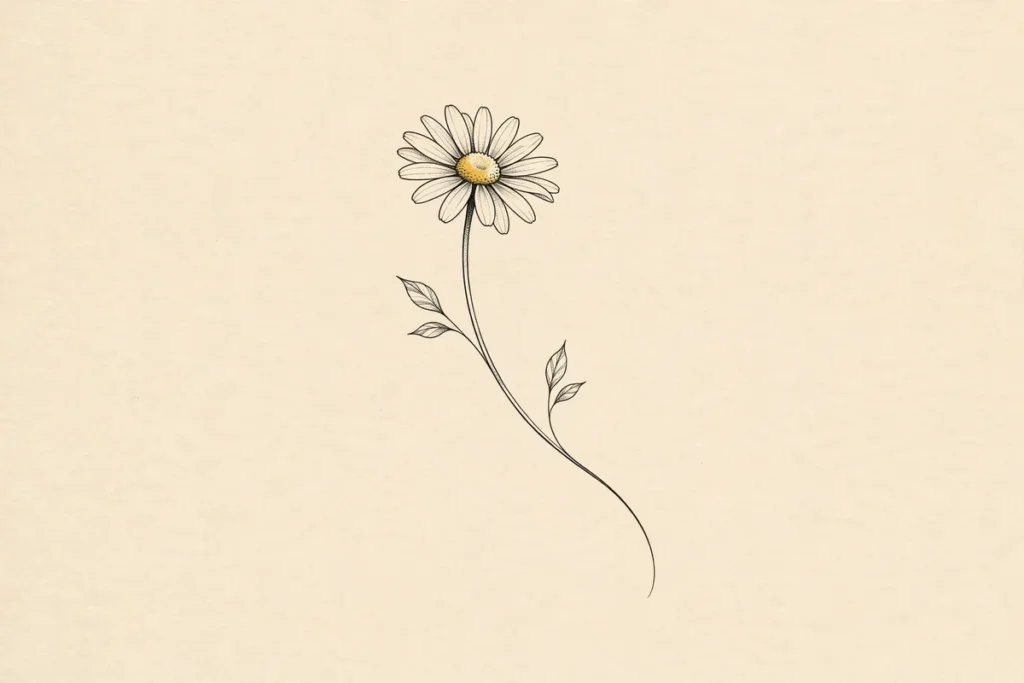
Placement: Inner forearm, ankle, or along the collarbone.
2. Daisy Chain
A daisy chain turns one flower into a rhythm. Several small daisies linked by thin stems can wrap around a wrist like a bracelet, circle an ankle, or arc across a collarbone. The chain has a handmade, nostalgic feel — most people made one as a child — and that memory is part of why the design resonates. Each flower can be the same size, or they can shrink gradually toward the ends for a more delicate finish.
Because the design is a repeating pattern, it adapts well to curved parts of the body. An artist can follow the line of your wrist or the shape of your shoulder so the chain sits naturally rather than looking stamped on. Keep the flowers small and the stems thin, and the result stays light and feminine rather than heavy.
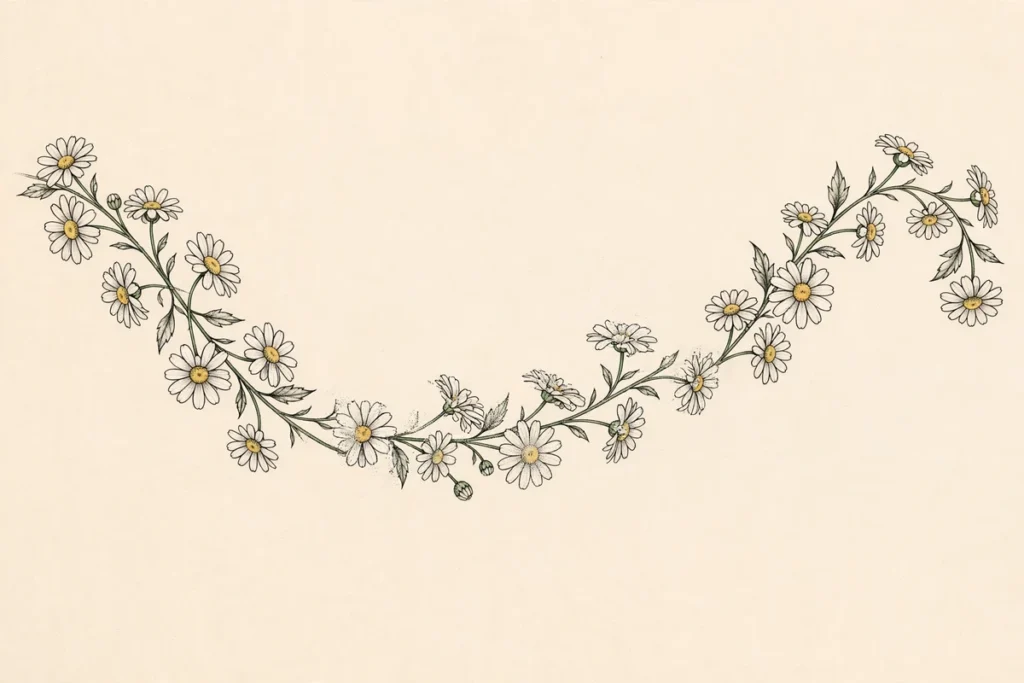
Placement: Around the wrist, ankle, or draped over the collarbone.
3. Watercolour Daisy
A watercolour daisy trades crisp outlines for soft, bleeding colour. The flower itself is drawn in fine ink, then washed with pale yellow, green, and a touch of blush pink that spills just past the lines, as though the tattoo were painted rather than inked. The effect is gentle and artistic, and it suits people who love colour but do not want a bold, saturated tattoo.
Watercolour work needs an artist who genuinely specialises in the style, because the soft edges have to look deliberate rather than faded. Ask to see healed watercolour pieces, not just fresh ones, since the washes settle and soften over the first year. Done well, it looks like a small painting on the skin, and suits a shoulder or upper arm where the colour has room to breathe.
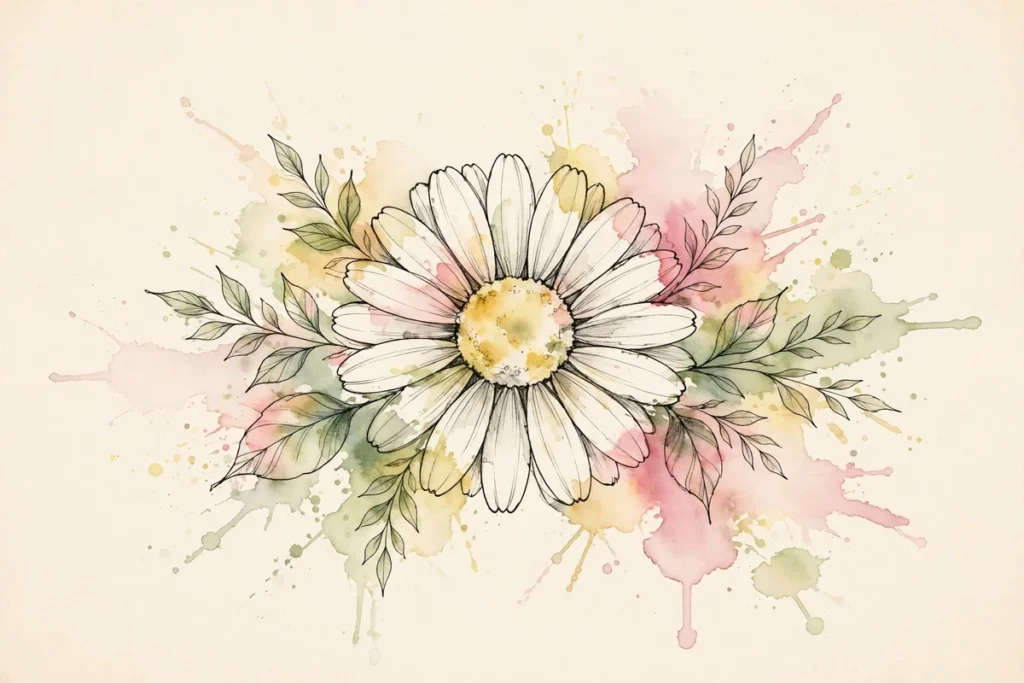
Placement: Shoulder, upper arm, or thigh.
4. Minimalist Daisy
The minimalist daisy is barely there — a thin outline, a few petals, a dot for the centre — and that restraint is the whole point. There is no shading, no colour, and nothing extra. It is the kind of tattoo that takes ten minutes in the chair and costs less than most, yet it carries the full meaning of the flower. For a first tattoo, that low commitment matters: it is easy to get, easy to hide, and easy to love.
Minimalist designs suit people who prefer quiet style in general — simple jewellery, plain clothes, clean lines. A tiny daisy behind the ear, on the side of a finger, or just above the wrist fits that aesthetic perfectly. Go too small and the lines can blur over the years, so let your artist set a sensible minimum size.
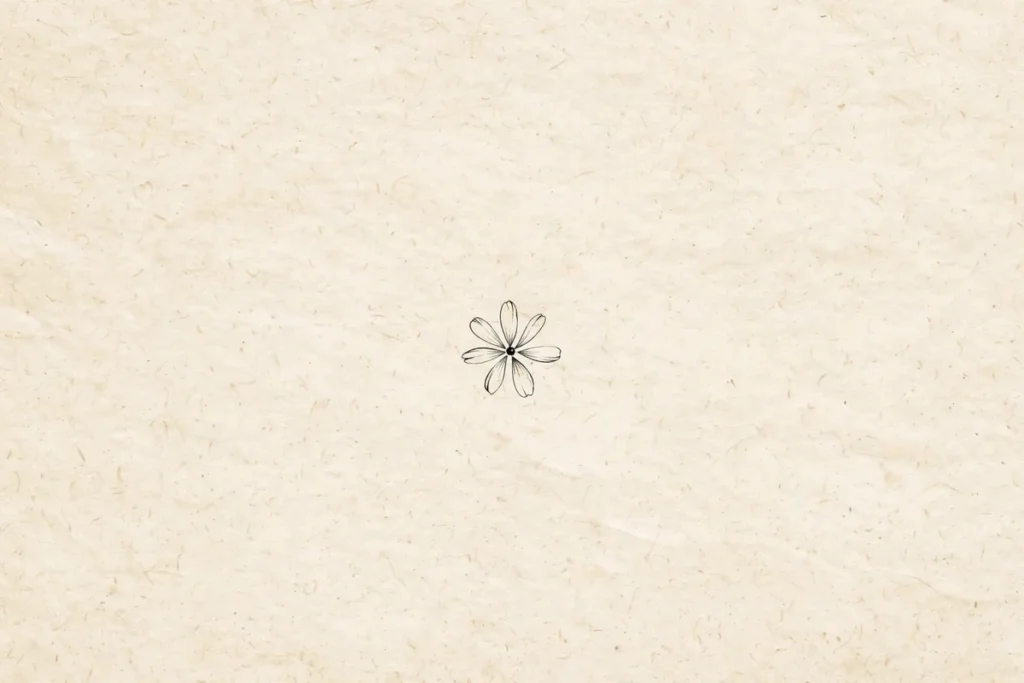
Placement: Behind the ear, side of the finger, or inner wrist.
5. Daisy and Bee
A daisy with a bee adds movement and a second layer of meaning. The bee brings its own symbolism — hard work, community, and finding sweetness in ordinary days — and the pairing feels natural, since bees and daisies belong together in a garden. The bee is usually drawn small, hovering just above or beside the flower.
This design works best when the bee is kept in proportion to the flower rather than competing with it. A daisy of three or four centimetres with a bee half that size keeps the balance right. It is a cheerful, optimistic tattoo, and a good pick for someone who wants their ink to say something about how they live: busy, useful, and drawn to simple pleasures.
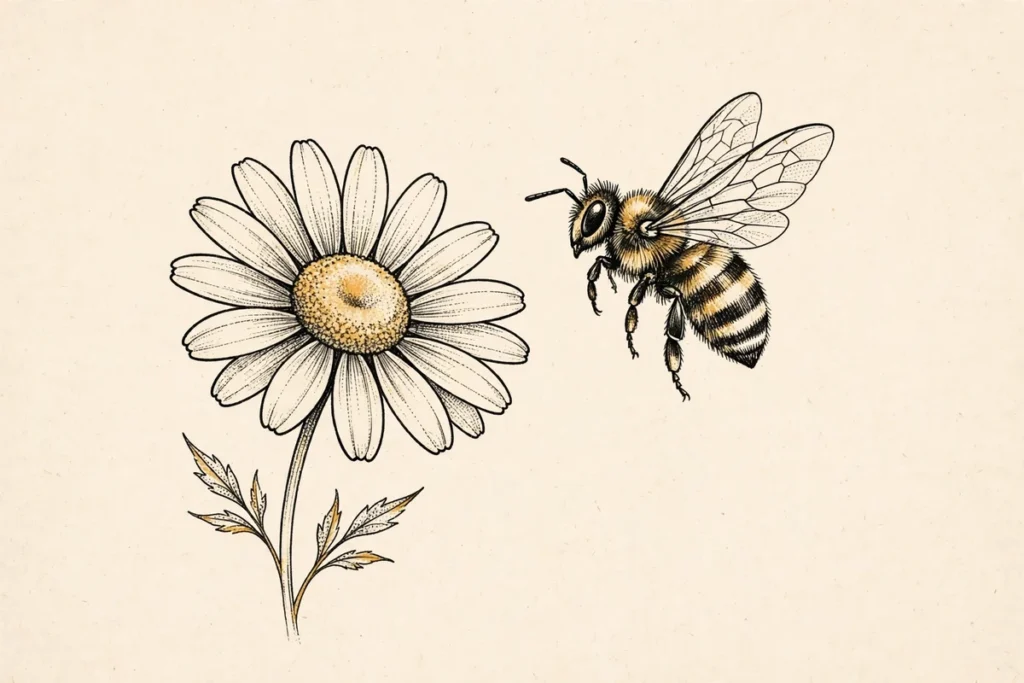
Placement: Forearm, calf, or the back of the shoulder.
6. Daisy Bouquet
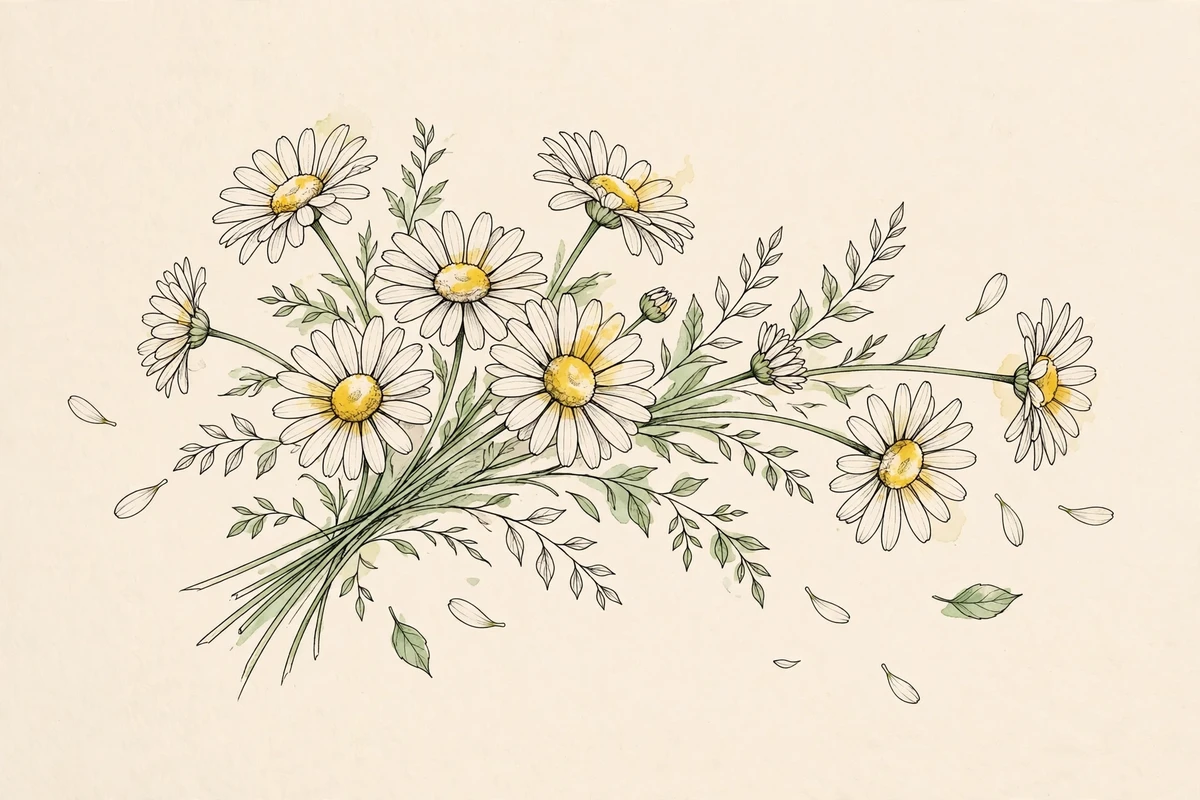
A daisy bouquet is the fullest version of the flower — several stems gathered and tied with a thin ribbon, the way a bunch of daisies looks when you have just picked them. The stems can be bound with a bow, a piece of twine, or a simple band, and a few loose petals or sprigs of greenery can be added around the edges. It is a romantic design, and it suits a larger placement where the bouquet has room to spread.
Because it is bigger, a bouquet gives the artist more to work with: varied petal angles, overlapping stems, and soft shading between the flowers. It is also a natural choice for a tribute piece — a bouquet can stand for a group of people, with one flower for each child, sibling, or close friend.
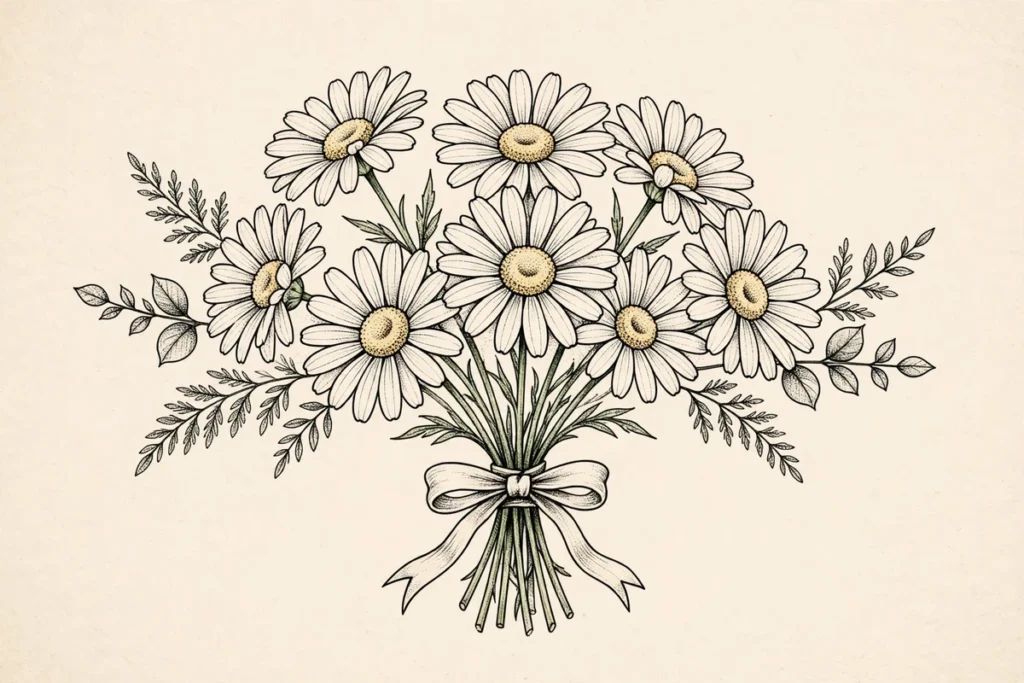
Placement: Upper arm, thigh, or across the shoulder blade.
7. Black-and-Grey Daisy
A black-and-grey daisy proves the flower does not need colour to be beautiful. Built from black ink, grey wash, and fine dotwork, the petals gain depth through shading rather than yellow and white, and the result is softer and more understated than a colour piece. It is a good choice for people who like the look of classic tattooing, or who want a floral tattoo that sits comfortably next to other black-and-grey work.
The shading is what makes or breaks this design. Soft gradients across each petal give the flower a realistic, almost three-dimensional feel, while the dotwork adds texture without weight. With no colour to fade, it holds up well over time, and touch-ups are simple. It suits a forearm or calf, where the shading can be seen properly in good light.
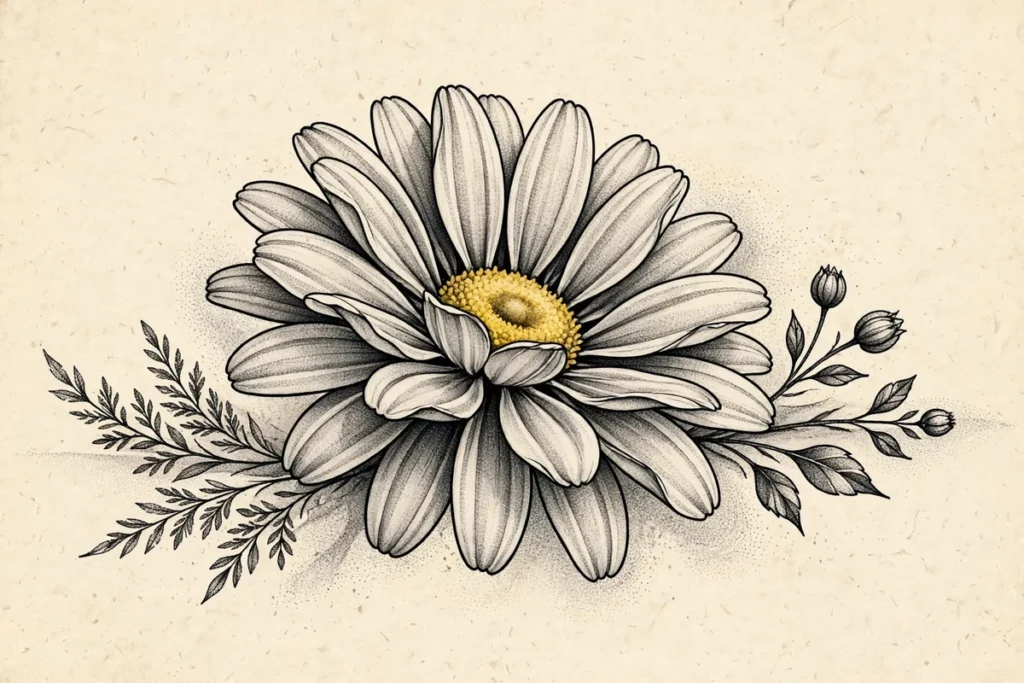
Placement: Forearm, calf, or upper arm.
8. Small Daisy on the Wrist
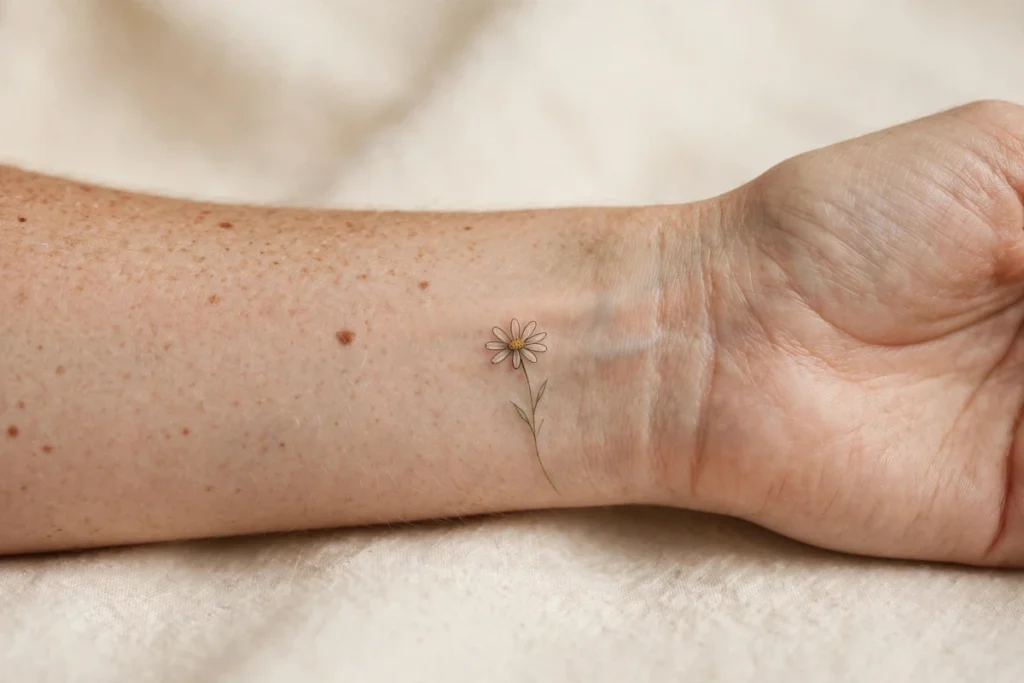
A small daisy on the wrist is one of the most popular placements for this flower, and it is easy to see why. The wrist is visible enough that you see the tattoo every day, small enough that the design stays delicate, and flat enough that a fine-line daisy sits cleanly. A single stem running along the wrist, or a tiny flower just below the palm, takes up almost no space and still makes its point.
The wrist is also a practical choice: it heals quickly, it is easy to show or cover with a watch or bracelet, and it suits a first tattoo because the session is short. The skin here is thin, so expect a little more sting than on the arm, and keep the design simple — a small daisy with a short stem and one leaf is plenty.
Placement: Inner wrist or just below the palm.
9. Daisy and Butterfly
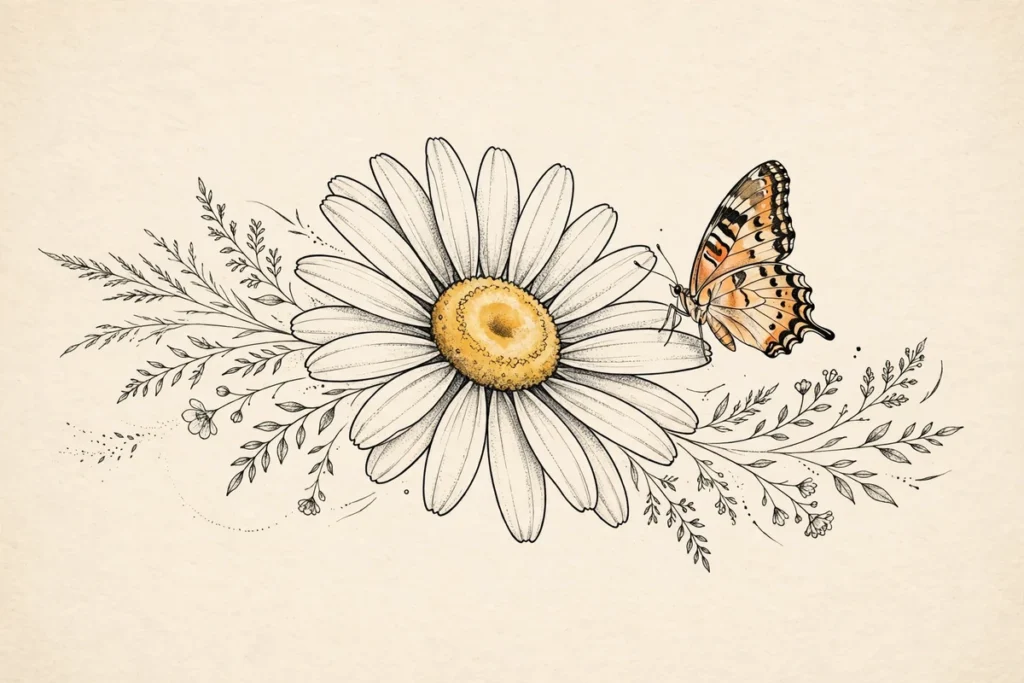
A daisy with a butterfly is a design about change. The butterfly — long associated with transformation and new life — rests on a petal or floats just above the flower, its wings carrying a touch of soft colour against the white of the daisy. Together, the two make a gentle statement about growth: the flower that stands for new beginnings, and the insect that has already lived through its own.
The key to this design is lightness. The butterfly should look as though it has just landed, not as though it were pinned to the flower, so the wings are best drawn slightly open and the body kept small. A hint of orange, blue, or lilac in the wings stops the piece from feeling monochrome without overpowering the daisy.
Placement: Ankle, shoulder, or back of the neck.
10. Daisy with a Name or Date
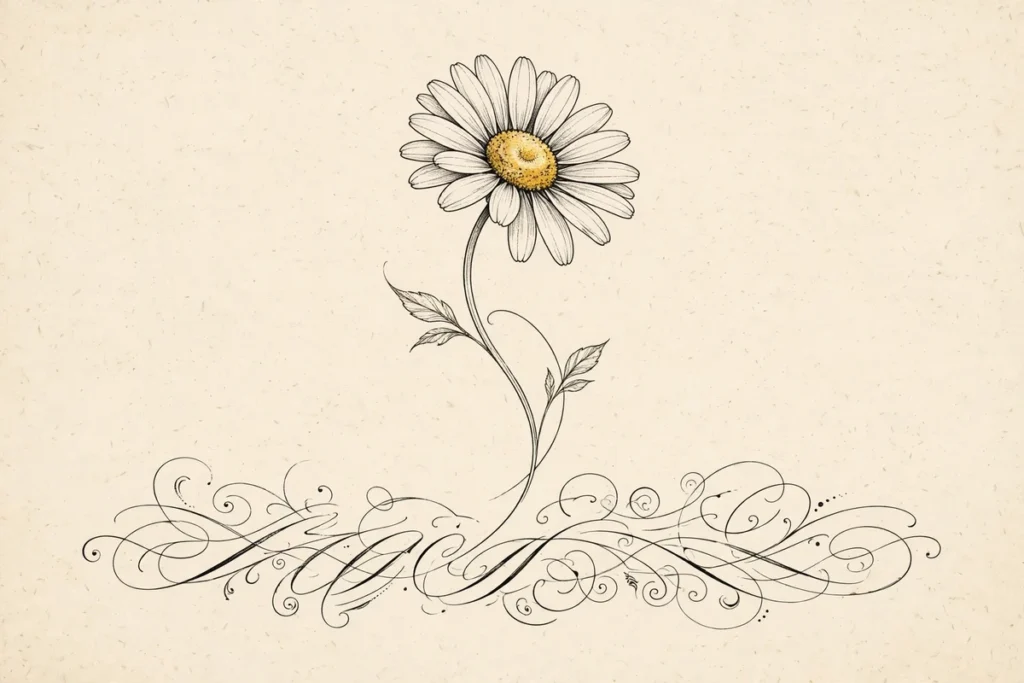
A daisy with a name or a date turns a pretty flower into a personal marker. The flower sits above flowing script — a child’s name, a partner’s name, a birth date, or a short word that matters — with the stem curving gently into the lettering so the two feel like one design rather than a flower with text bolted on underneath. It is the most personal design in this list, and the one most often chosen to mark a birth, a wedding, or a loved one’s memory.
Script is where this tattoo succeeds or fails, so choose the lettering with care and check it twice. Choose a simple, legible hand over an ornate one, and check the exact font at the exact size before the needle touches skin. Daisies also combine well with other flowers in a name piece — a daisy beside a rose, for example, can stand for two people at once. If you like that idea, see our 21 rose tattoo ideas for designs that pair well with a daisy.
Placement: Forearm, ribs, or across the collarbone.
Closing
A daisy tattoo works because the flower itself does so much with so little: white petals, a yellow centre, and a meaning — innocence, new beginnings, loyal love — that fits almost any chapter of a life. Whatever you choose — a single stem, a watercolour bouquet, or a flower with a name beneath it — the design stays light, readable, and easy to wear for years.
Take your time choosing the version that feels like yours, and take the same care choosing the artist. Clean lines and honest shading are what keep it looking good a decade from now. Pick the design, pick the spot, and let a small white flower say what you want it to say.