Introduction
Few tattoo subjects have lasted as long as the rose. It has been inked for well over a century, and it still shows up in studios every single day — on first-timers, on collectors, on people marking a loss and on people celebrating a love. Part of the appeal is simple: a rose looks good in almost any style, at almost any size, on almost any part of the body.
The other part is meaning. A rose can stand for love, for beauty, for a memory, or for the balance between softness and strength — the bloom and the thorns. Change the colour, the style or the companion imagery and the message changes with it, which is why no two rose tattoos ever really feel the same.
This list covers 21 ideas across the styles people ask for most: fine-line, blackwork, watercolour, realistic, traditional, geometric and dotwork. Some are small enough to hide under a watch strap, others are made to fill a whole back. Read through, notice which ones you keep coming back to, and take your favourite to your artist as a starting point — not a copy to trace.
21 Rose Tattoo Ideas
1. Classic Red Rose
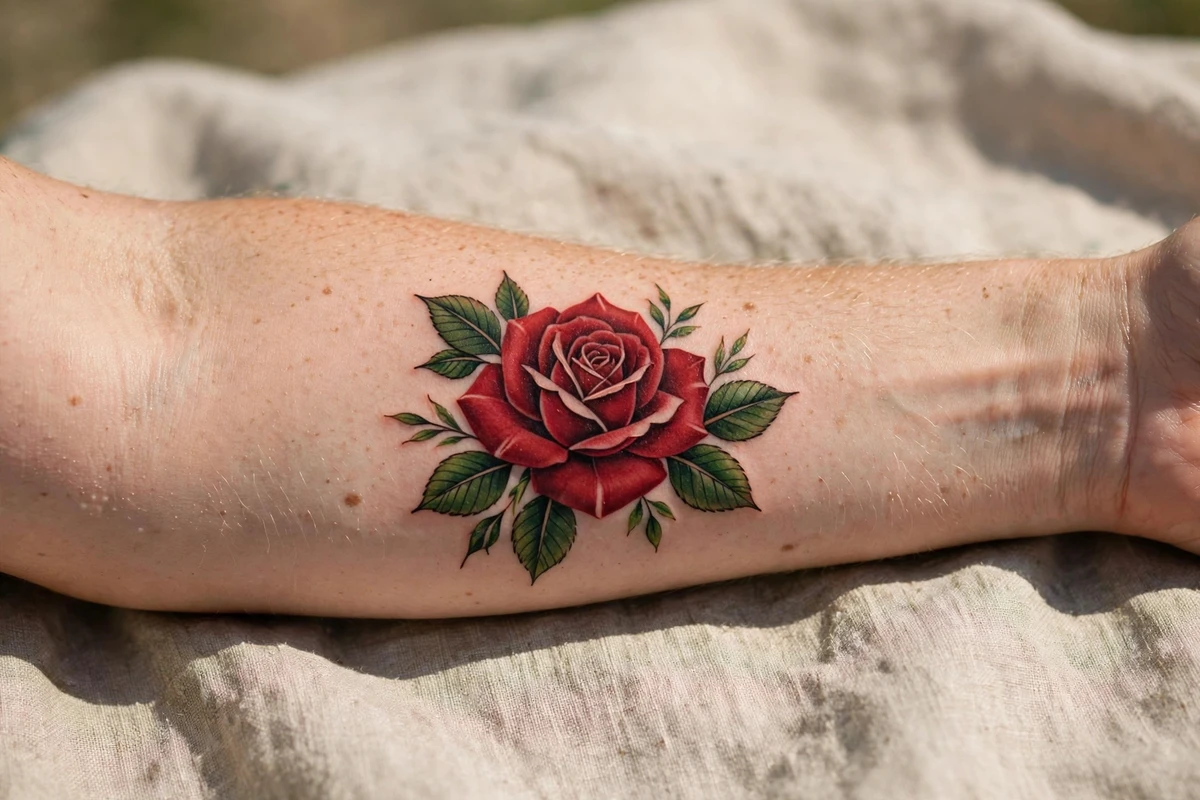
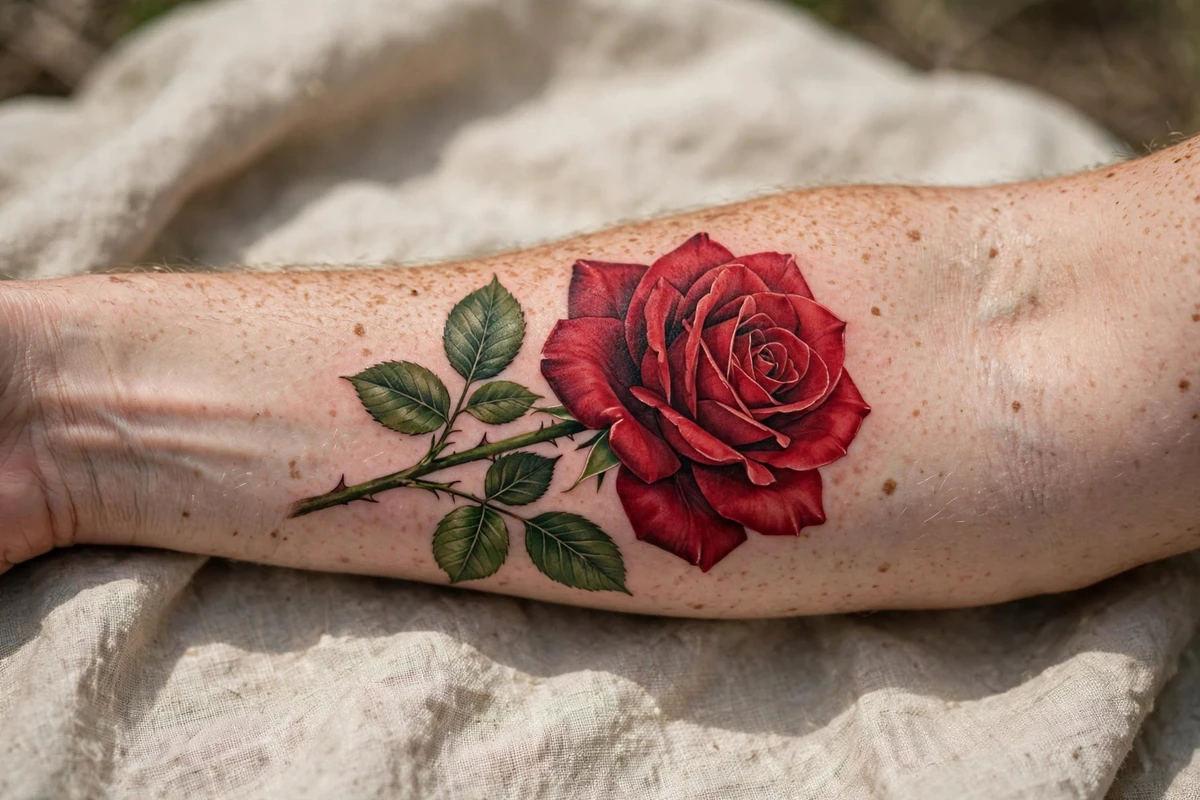
The red rose is the original. A single bloom in deep red with green leaves has been a tattoo staple since the early days of Western tattooing, and it has never really gone out of fashion. It reads instantly as love and passion, which is why it is still the most requested rose of all.
A good classic red rose depends on clean shading in the petals. Ask your artist for soft gradients rather than flat colour, so the bloom has depth and looks like it is opening rather than sitting flat on the skin. A little dark green in the leaves keeps the red from overpowering the design.
Placement: Forearm or upper arm — a classic spot that shows the design off without it needing to be large.
2. Fine-Line Single Rose
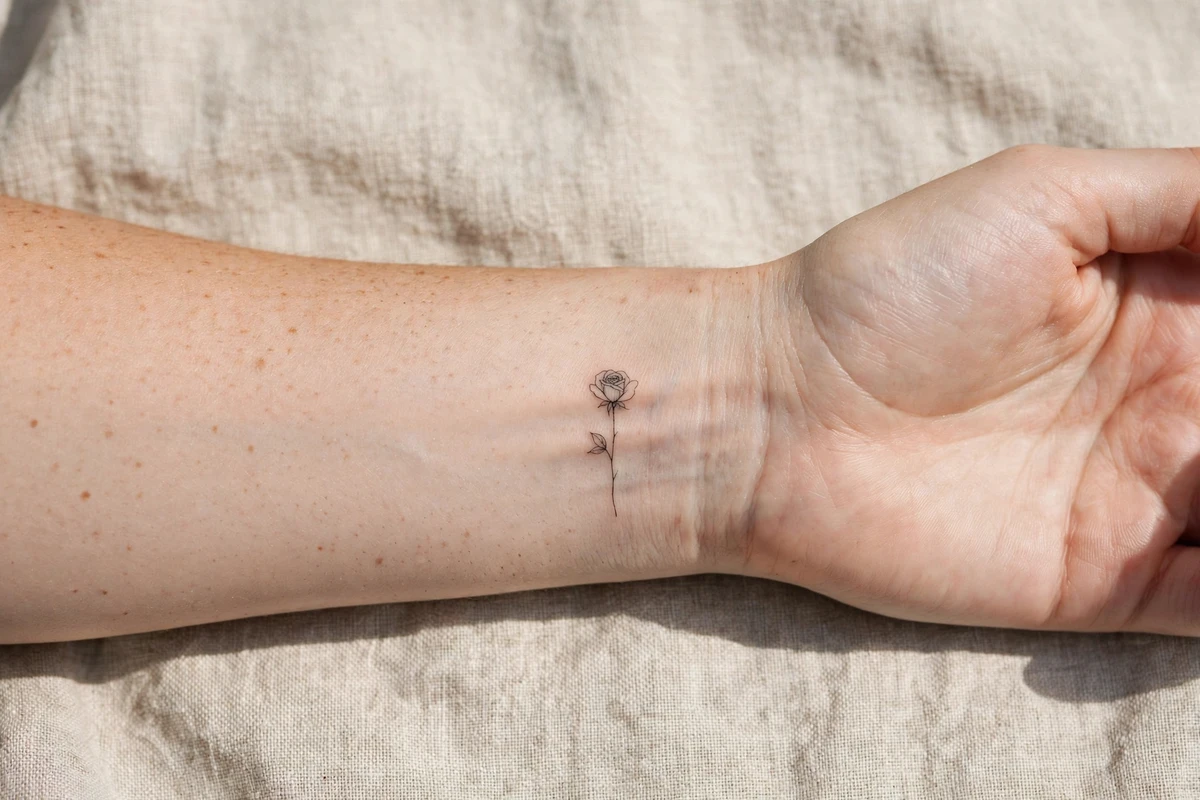
Fine-line work uses thin, delicate needles, and a single rose drawn this way looks more like an illustration than a traditional tattoo. The petals are suggested with a few confident lines instead of heavy shading, which gives the piece a light, airy feel.
This style suits people who want something elegant and understated. It also ages gracefully when the lines are kept bold enough — ask your artist to avoid lines so fine they blur over time. A single rose with a short stem and one small leaf is all this design needs.
Placement: Inner wrist or just below the collarbone, where the delicate lines can be appreciated up close.
3. Blackwork Rose
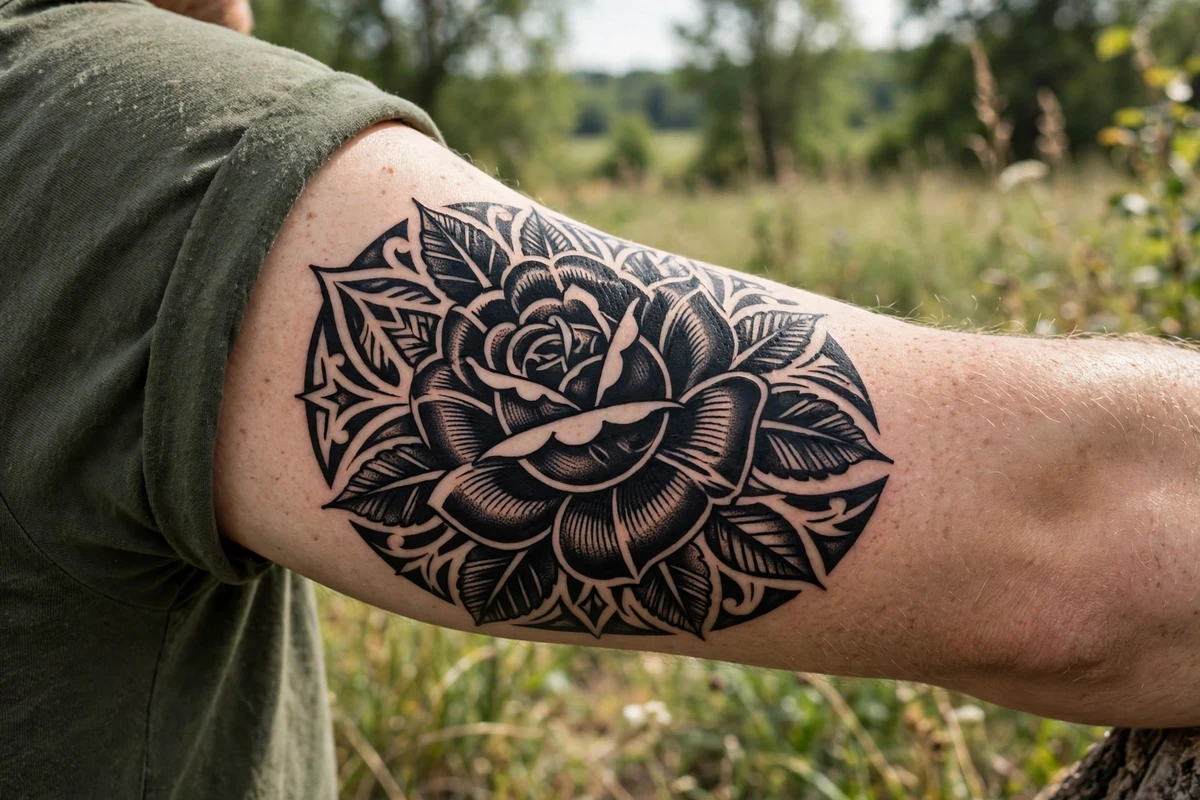
Blackwork strips the rose down to black ink only, using solid fills, bold outlines and heavy contrast. The result is dramatic: a rose that looks carved rather than painted, with deep shadows in the folds of the petals.
Because there is no colour to hide behind, the linework has to be precise. Blackwork roses work best when the artist has a strong grasp of shading, building the bloom out of layered black and negative space. It is a strong choice if you like bold tattoos and want something that will stay readable for years.
Placement: Upper arm or calf, where there is enough space for the bold shading to breathe.
4. Watercolour Rose
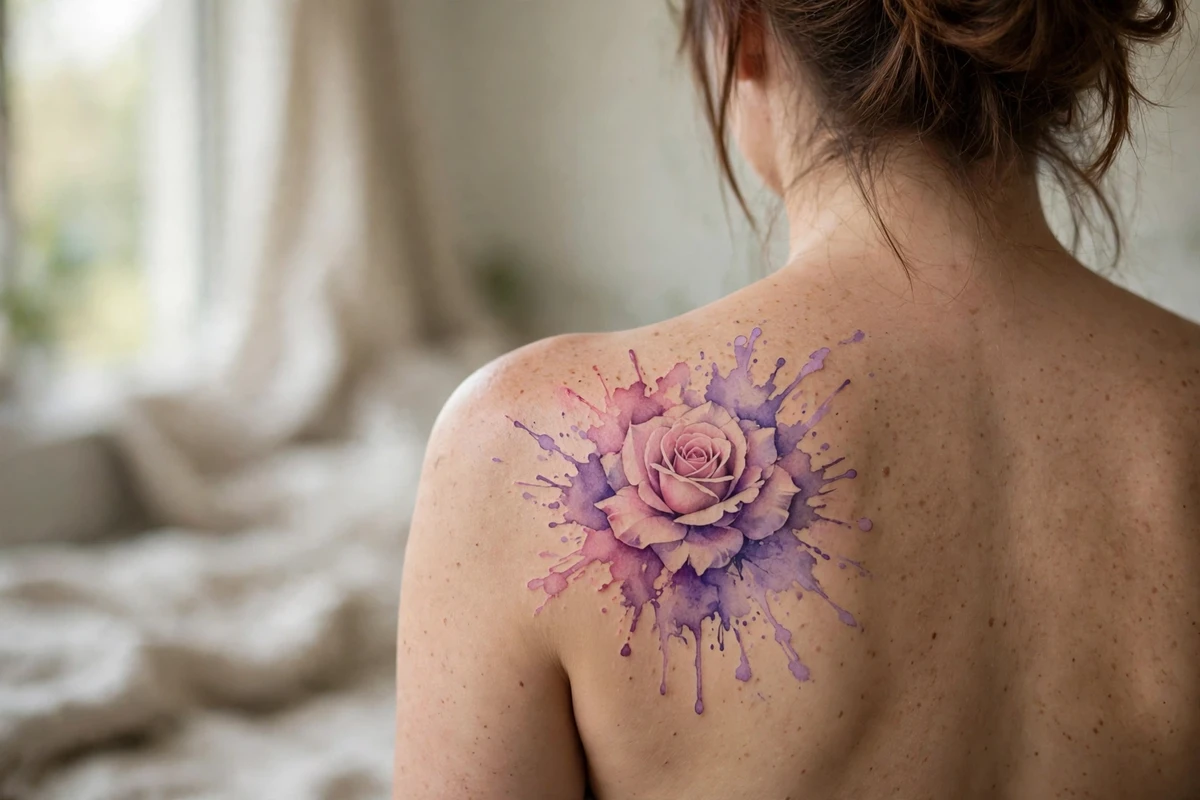
A watercolour rose looks as though it was painted with a brush: soft washes of pink, red or purple bleeding gently past the outlines, with no hard edges in the colour. The effect is romantic and painterly, and no two watercolour pieces ever look identical.
The trick with this style is finding an artist who genuinely specialises in it. Watercolour needs confident colour blending and an understanding of how the washes will settle as the tattoo heals. Pair it with a light black or grey outline so the design keeps its shape as the colour softens over time.
Placement: Shoulder blade or upper thigh — a flat, smooth area where the colour washes can spread naturally.
5. Realistic Rose
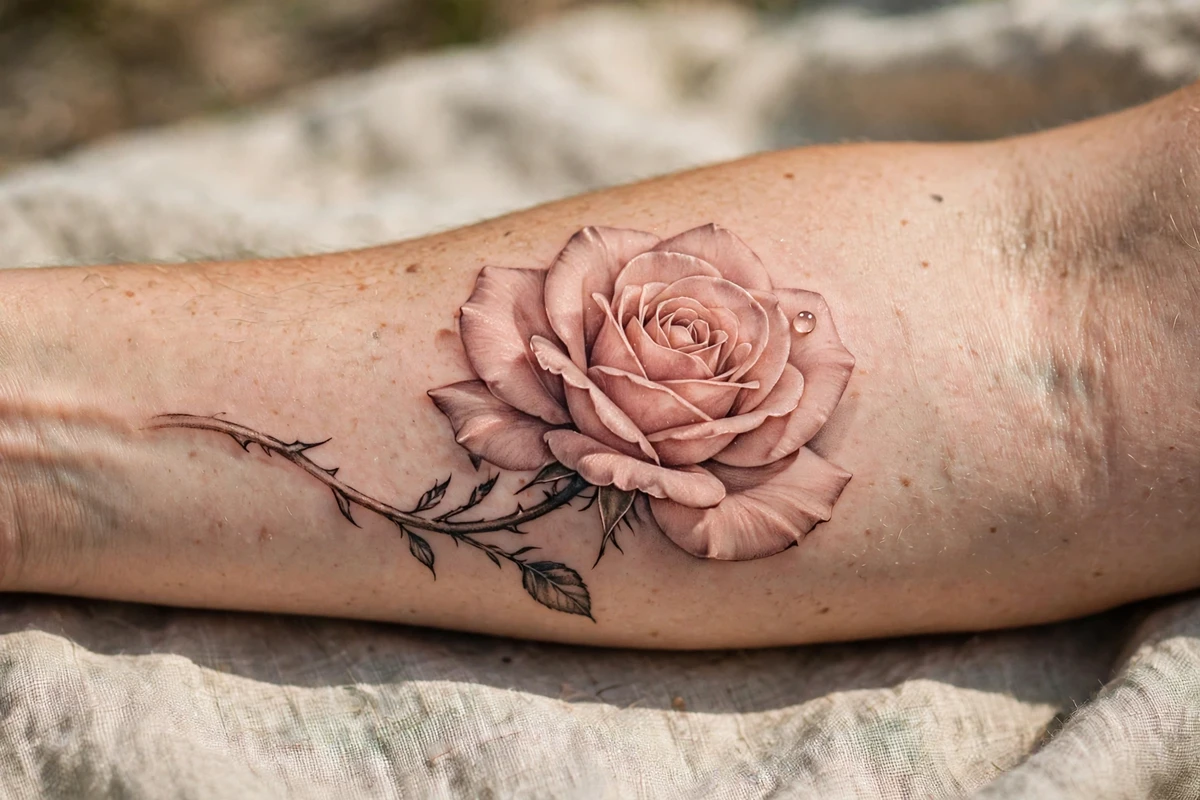
A realistic rose aims to look like a photograph of a flower, complete with soft light on the petals, dewdrop highlights and a natural curve to the stem. When done well, it is the most striking rose style there is — and the most demanding on the artist.
Realism needs a specialist. Look through portfolios for healed realistic floral work, not just fresh photos, because fine detail in petals can soften as the tattoo settles. Expect this one to take longer in the chair and to cost more than a simpler style, but the result is a piece that genuinely turns heads.
Placement: Forearm or shoulder, where the detail is visible and the skin is smooth enough to hold it.
6. Traditional American Rose
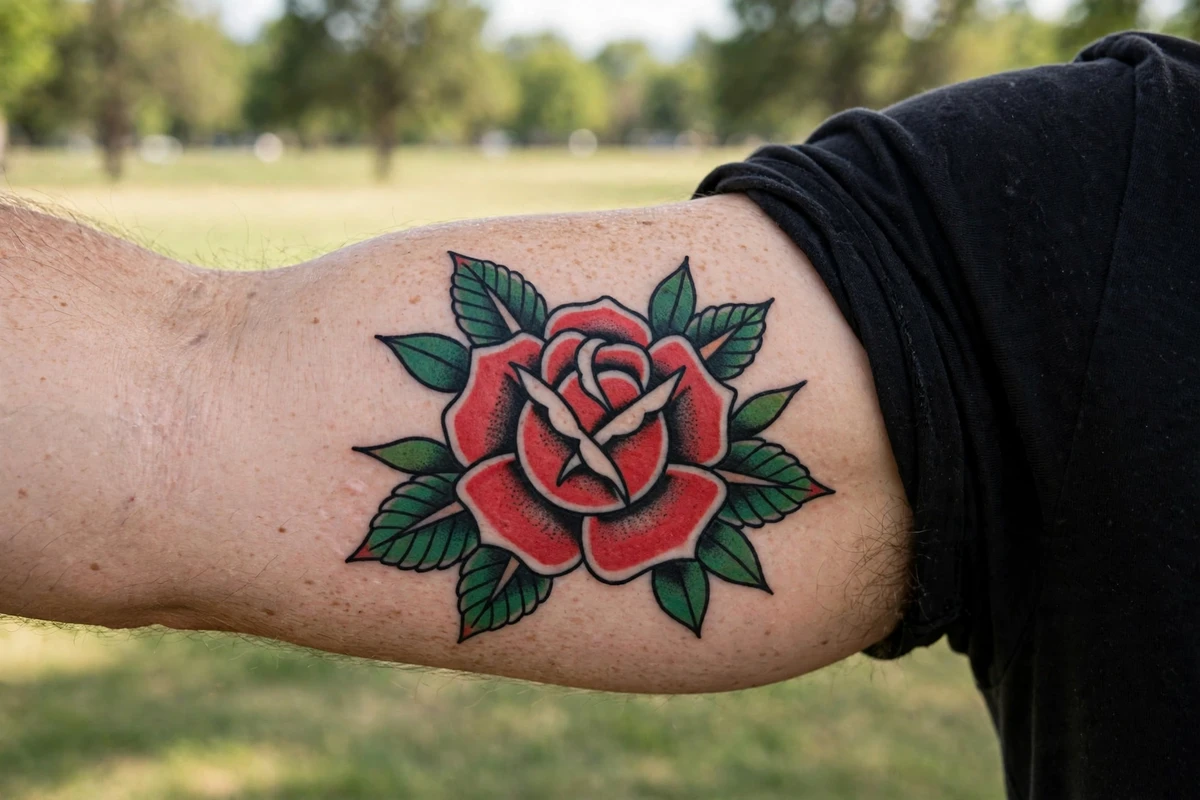
The traditional American rose — bold black outlines, solid red fill, limited shading, a couple of green leaves — has been a tattoo parlour classic for generations. It is the style sailors and old-school collectors wore, and it still looks right today.
What makes it last is the simplicity. Thick lines and solid colour hold up better over decades than delicate detail, so a traditional rose will still read clearly long after finer styles have softened. If you like tattoos with history and want something that ages well, this is the safest bet on the list.
Placement: Outer forearm or bicep, the classic old-school spots.
7. Geometric Rose
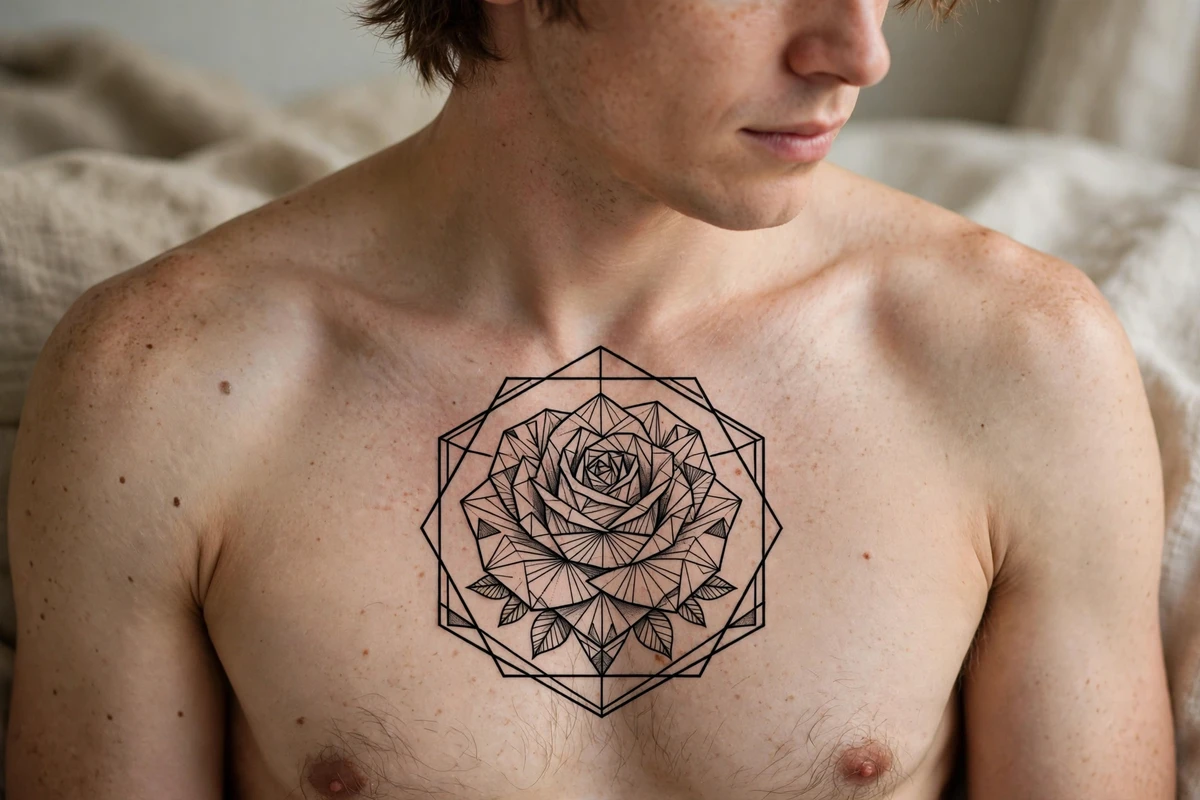
A geometric rose blends the organic curves of the flower with clean straight lines, triangles and symmetry. Sometimes the rose sits inside a geometric frame; sometimes the petals themselves are built from angular shapes. Either way, the contrast between nature and geometry is what makes it work.
This style suits people who like modern, structured design. Keep the linework crisp and the composition balanced — a slightly off-centre frame will show. Some artists add dotwork shading or a small mandala element around the rose to complete the look.
Placement: Chest centre or upper back, where the symmetry of the design can sit evenly.
8. Dotwork Rose
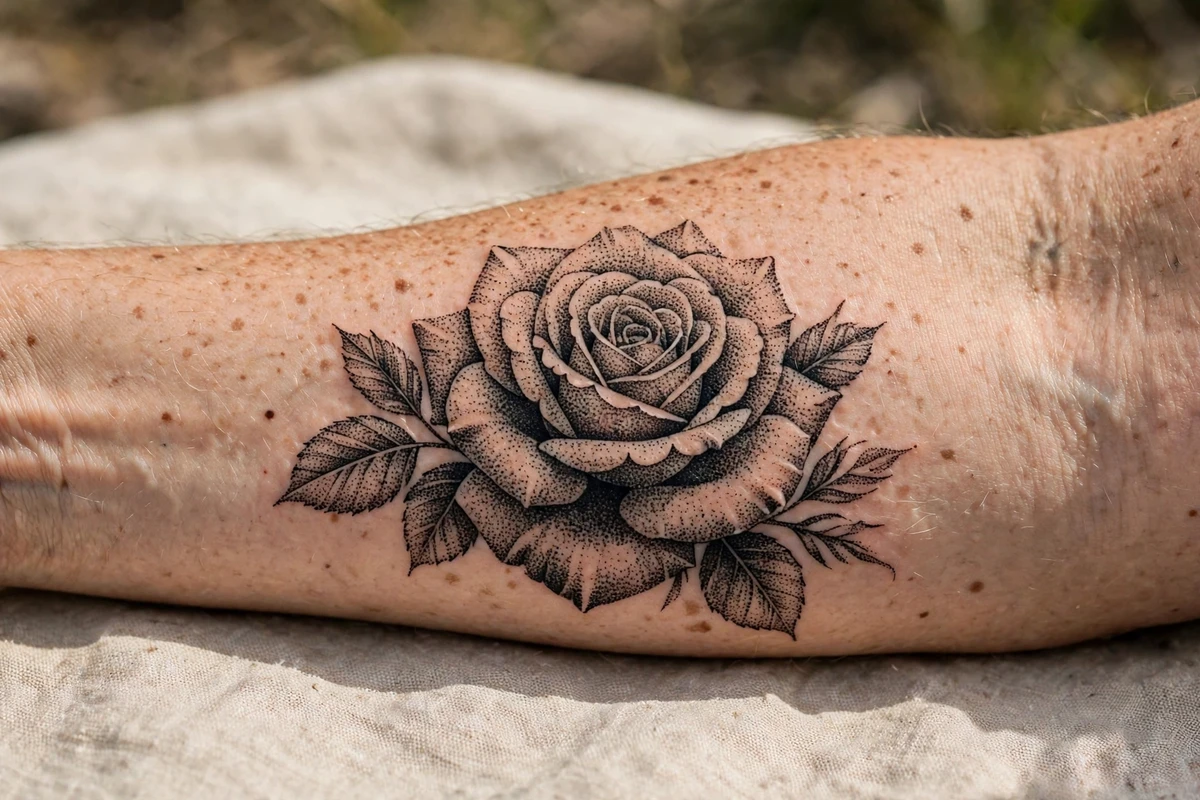
Dotwork builds the rose entirely out of tiny dots, with denser clusters for shadow and sparse dots for light. Up close it looks like stippled ink; from a distance it reads as a soft, shaded rose with a texture no other style can match.
Dotwork takes patience — both from the artist and from you, since the piece takes longer than a lined design of the same size. The payoff is a tattoo with a gentle, almost faded quality that feels more like an etching than a standard tattoo. It pairs beautifully with fine-line stems and leaves.
Placement: Forearm or ribs, where the dot gradient has room to develop across the design.
9. Small Rose on the Wrist
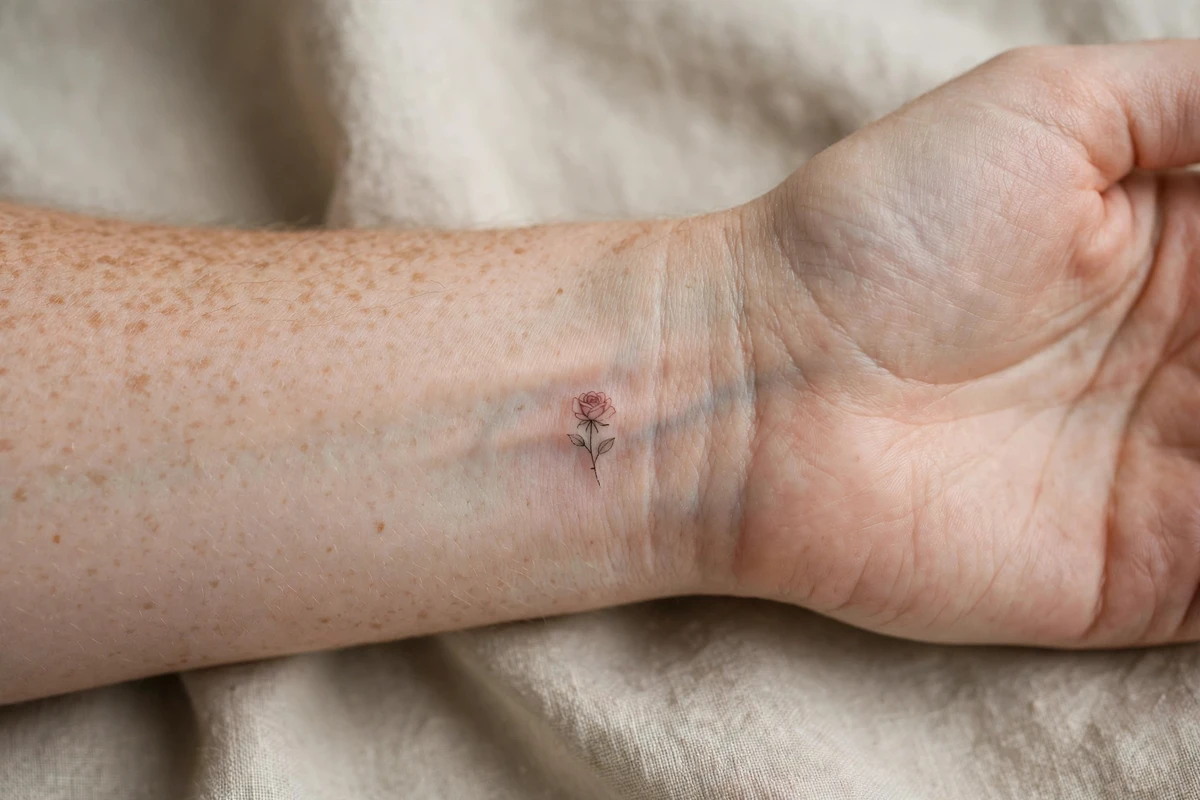
A tiny rose on the wrist is one of the most popular first tattoos, and for good reason. It is discreet, it heals quickly, and it is easy to show or cover depending on the day. A single small bloom with a short stem is enough — this is not a design that needs extra elements.
Keep the detail minimal at this size. Fine lines and a simple petal structure will hold up better than a miniature version of a large design. If you want colour, a soft red or pink works; if you prefer black and grey, a lightly shaded outline rose looks just as good.
Placement: Inner wrist, small and centred so it sits naturally when the arm rests.
10. Rose and Stem on the Forearm
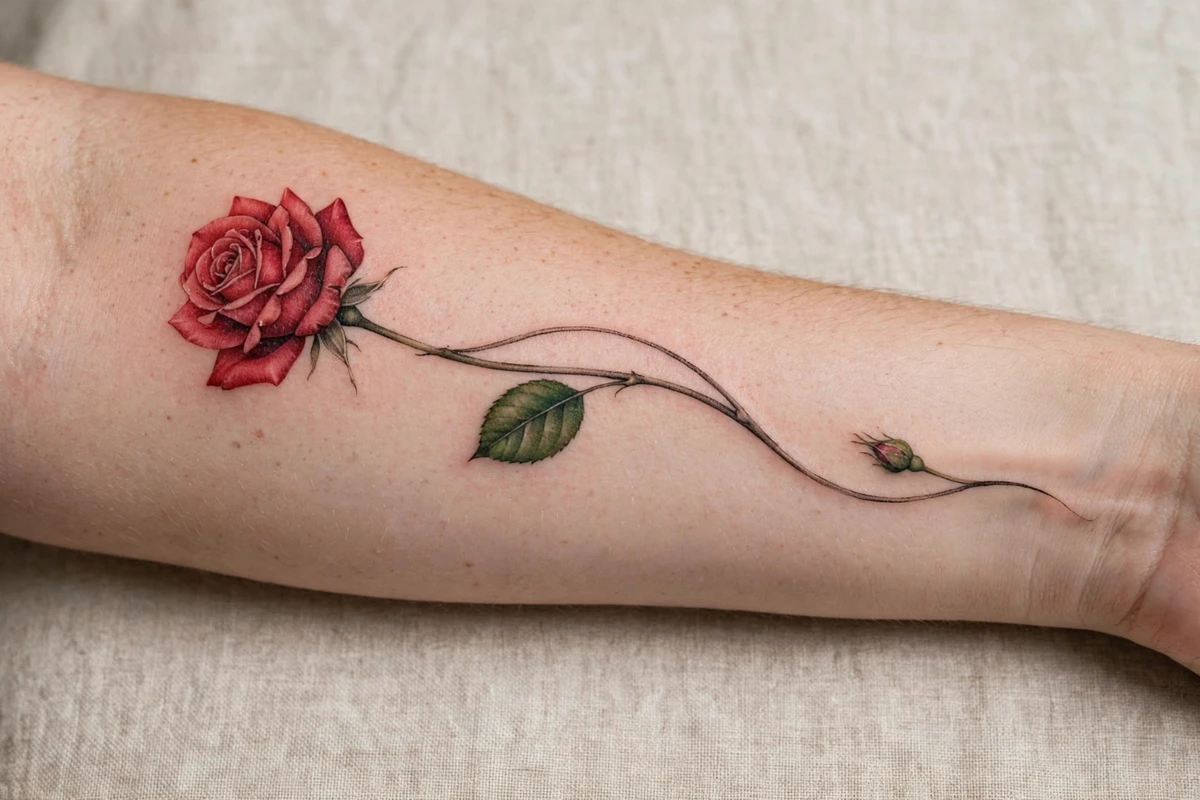
A long-stemmed rose running down the forearm is elegant and easy to wear. The stem gives the design a natural vertical flow, and the forearm is one of the least painful places to get tattooed, which makes it a friendly choice for a first larger piece.
The stem can be kept straight and simple, or given a gentle curve with a leaf or two and a single thorn. Some people add a small bud further down the stem, as though the rose is still growing. The forearm’s flat surface also takes fine detail well, so the petals can carry more shading than a wrist piece.
Placement: Inner or outer forearm, running lengthwise from elbow toward wrist.
11. Rose on the Shoulder
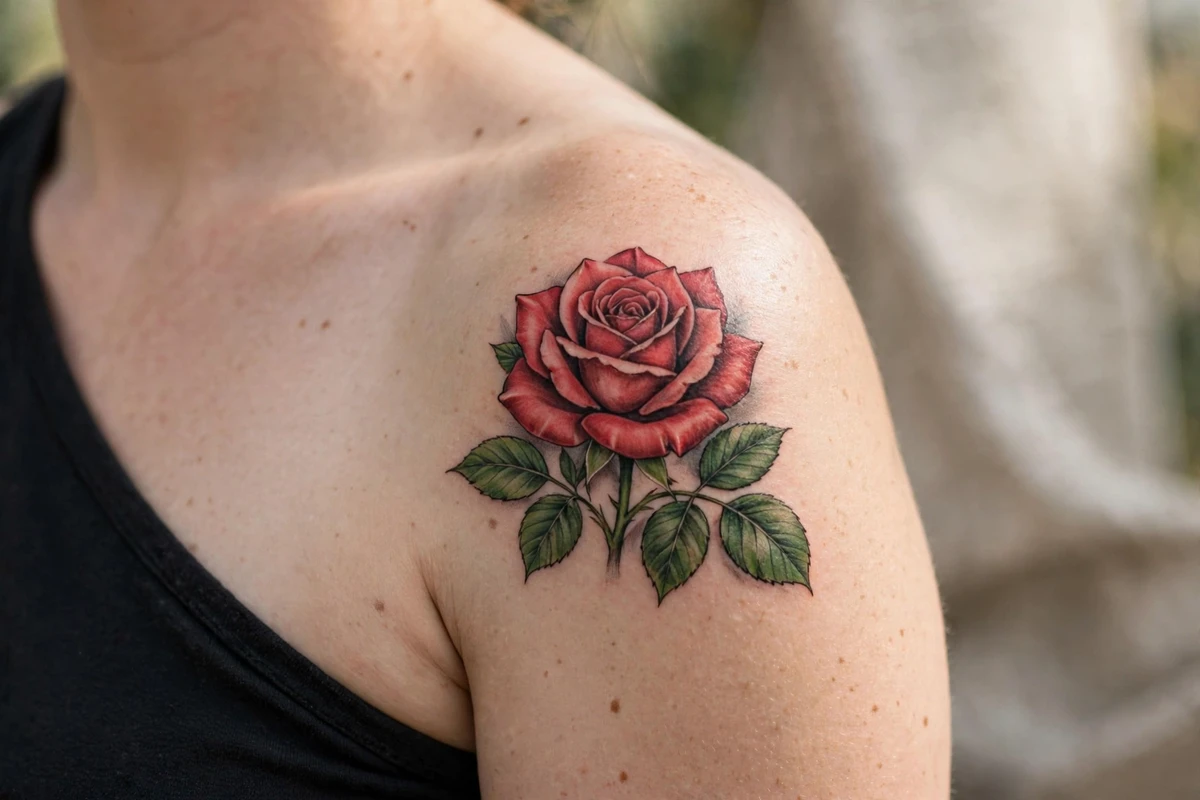
The shoulder is a natural canvas for a rose: the curve of the muscle suits the curve of the bloom, and the design can wrap slightly toward the collarbone or down the upper arm. A rose here feels both decorative and personal — visible in a sleeveless top, hidden under a shirt.
A medium-sized rose with a couple of leaves works best, since the shoulder gives enough space for shading without the design needing to be huge. This is also a good spot for a first colour piece, as the skin here tends to heal well.
Placement: Top of the shoulder, with the bloom centred on the curve of the muscle.
12. Large Rose Back Piece
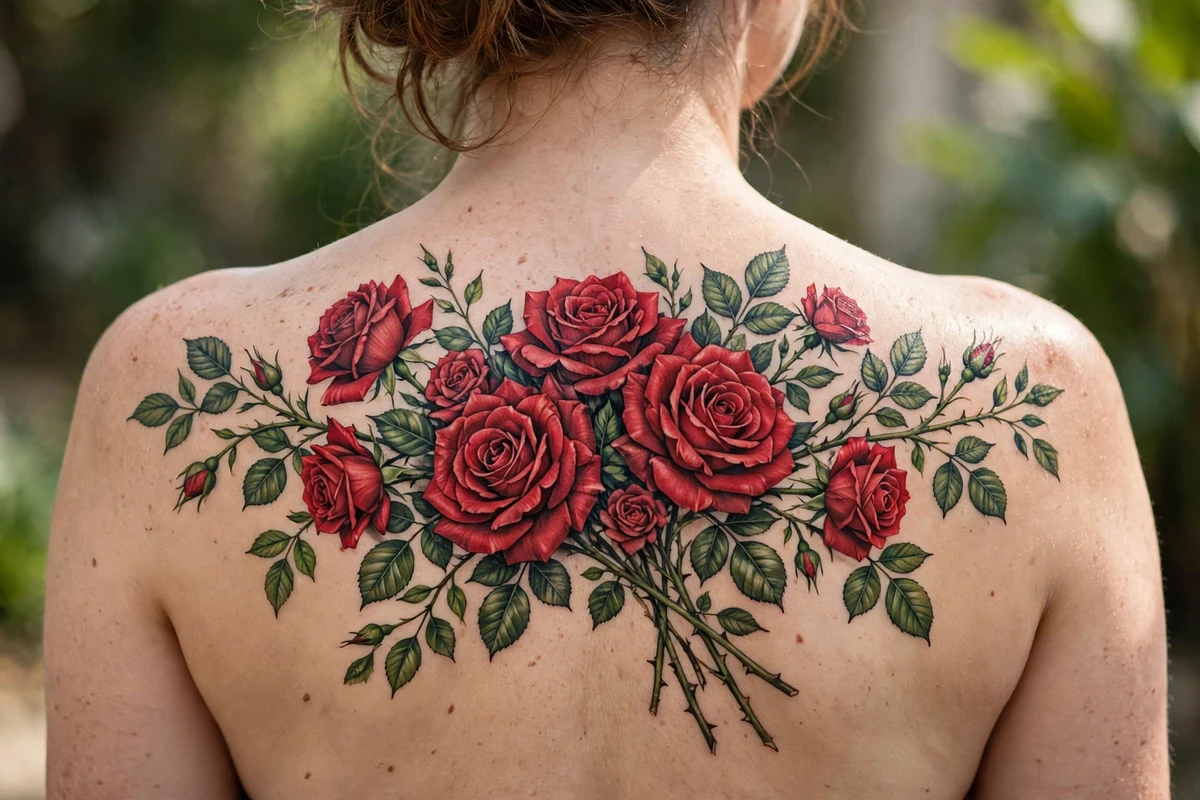
For those who want to make a statement, a large rose — or a bouquet of roses — across the upper or full back is hard to beat. The back offers the biggest flat canvas on the body, so the artist can build in real detail: layered petals, long stems, leaves and companion elements.
A back piece is a commitment. It will take multiple sessions, and you will not see it yourself without a mirror, so choose an artist whose larger work you trust. The result, though, is a centrepiece tattoo that can carry the rest of a collection around it.
Placement: Upper back between the shoulder blades, or a full back piece centred on the spine.
13. Rose and Butterfly
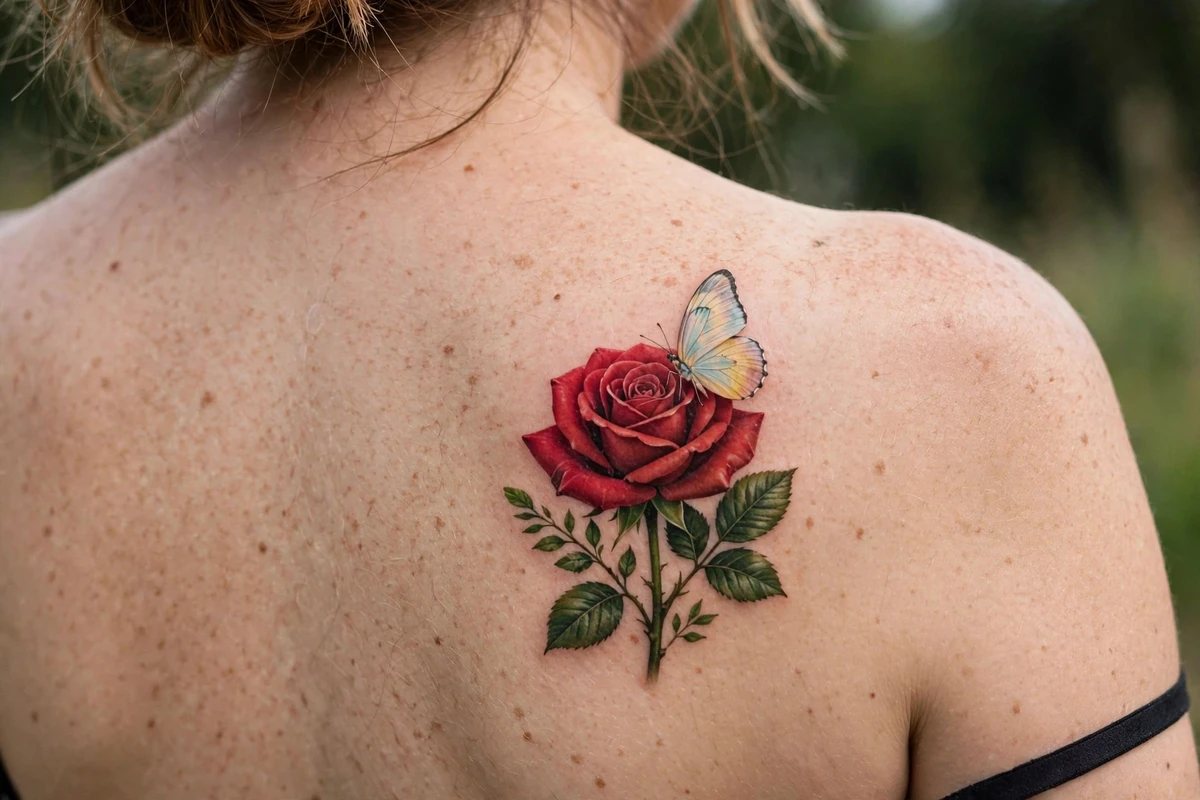
A rose with a butterfly is a pairing that never feels forced. The butterfly adds movement and lightness to the rose’s stillness, and together they suggest change, growth and new beginnings. It is a popular choice for marking a fresh chapter in life.
The butterfly can sit on the bloom, hover beside it, or fly up from the stem. Keep the butterfly’s wings delicate — heavy black wings will overpower the rose. A touch of colour in the wings, even on a black-and-grey rose, can tie the two elements together beautifully.
Placement: Shoulder blade or thigh, where both the rose and the butterfly have room to sit naturally.
14. Rose with a Name or Date
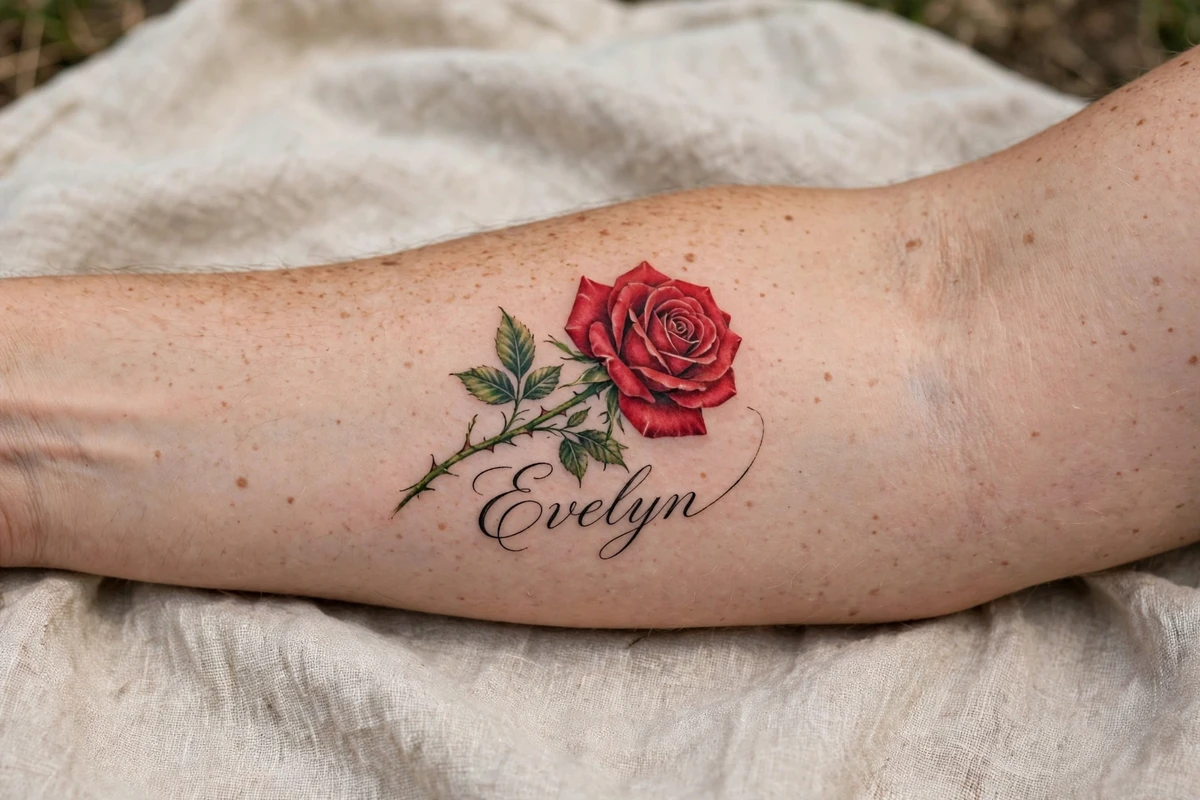
Adding a name or a date turns a rose from a beautiful design into a personal one. It is a common way to honour a partner, a child or someone who has passed away, with the rose standing for the love that connects the two.
Script matters here. Choose a lettering style you can read easily at a glance, and place the text so it flows with the design rather than fighting it — curved gently under the bloom or running along the stem. Keep the text short; a single name or a date in Roman numerals is usually enough.
Placement: Forearm, where the text stays readable, or over the heart on the chest for a memorial piece.
15. Black-and-Grey Rose
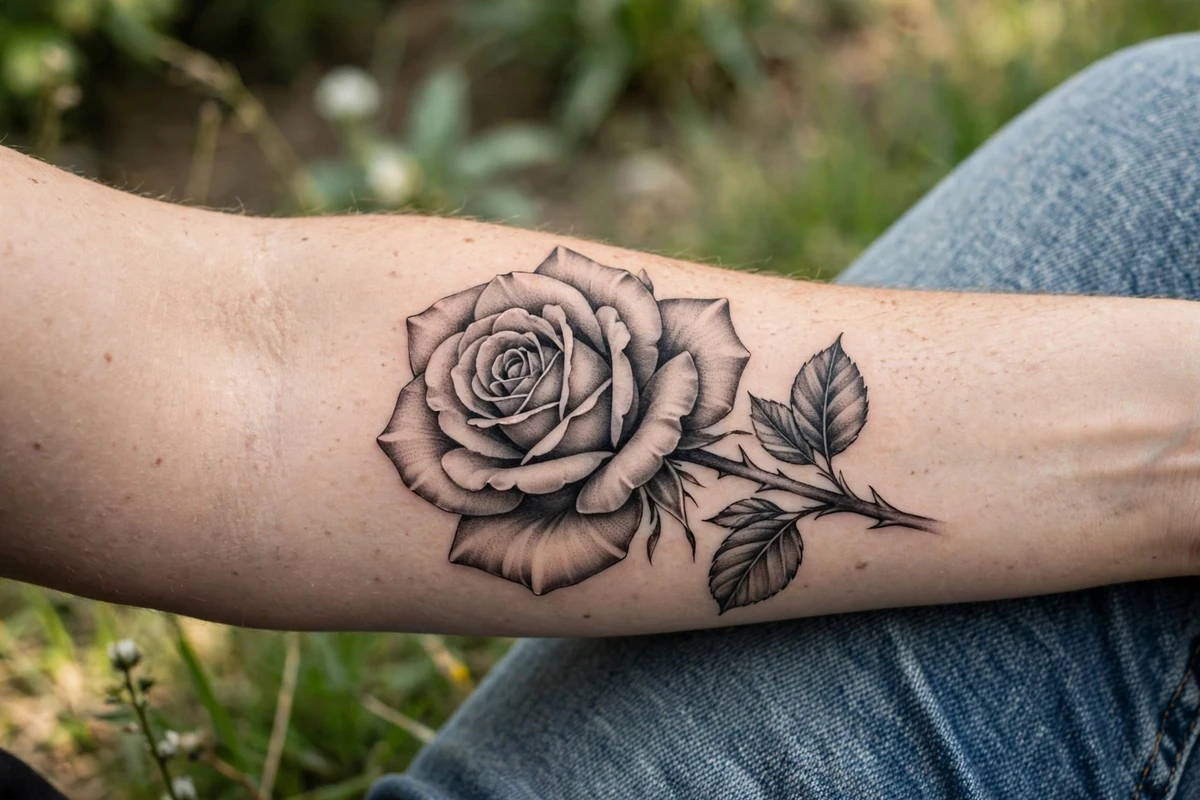
A black-and-grey rose uses only black ink and shades of grey to build the bloom. Without colour, the focus falls entirely on shading and form, and a skilled artist can make the petals look soft, velvety and almost three-dimensional.
This is a versatile choice: it suits every skin tone, it ages well, and it pairs easily with other black-and-grey work if you plan to build a sleeve or a larger collection. It also works beautifully at small sizes, where colour might otherwise look muddy.
Placement: Forearm or calf — anywhere the grey shading can be seen clearly in natural light.
16. Rose with Thorns
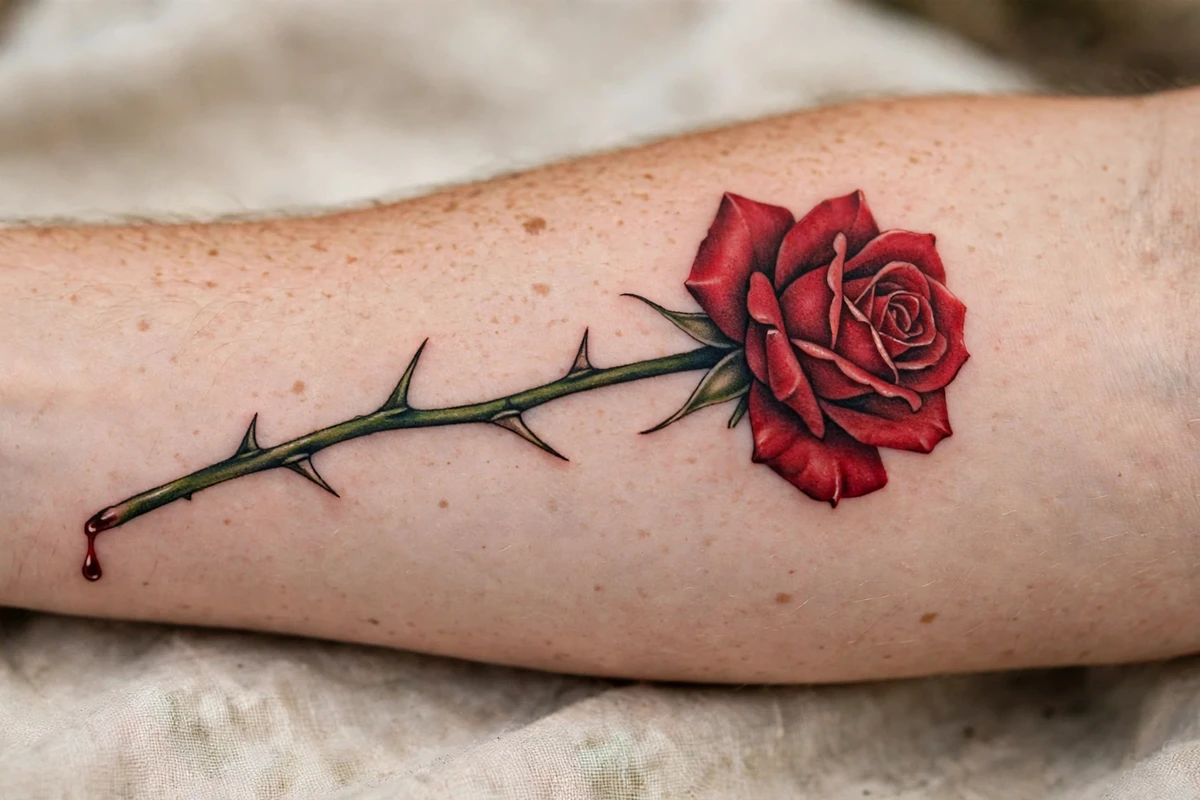
A rose with thorns says something the bloom alone does not: that beauty and toughness can live in the same place. It is a popular design for people who want their tattoo to carry a little edge, or to mark a difficult time they came through.
The thorns should be drawn with care — too many and the design looks cluttered, too few and the point is lost. A long stem with three or four well-placed thorns, and maybe a single drop of red at one tip, gives the design its bite without overwhelming the rose itself.
Placement: Forearm, running along the arm so the stem and thorns have space to show.
17. Rose and Snake
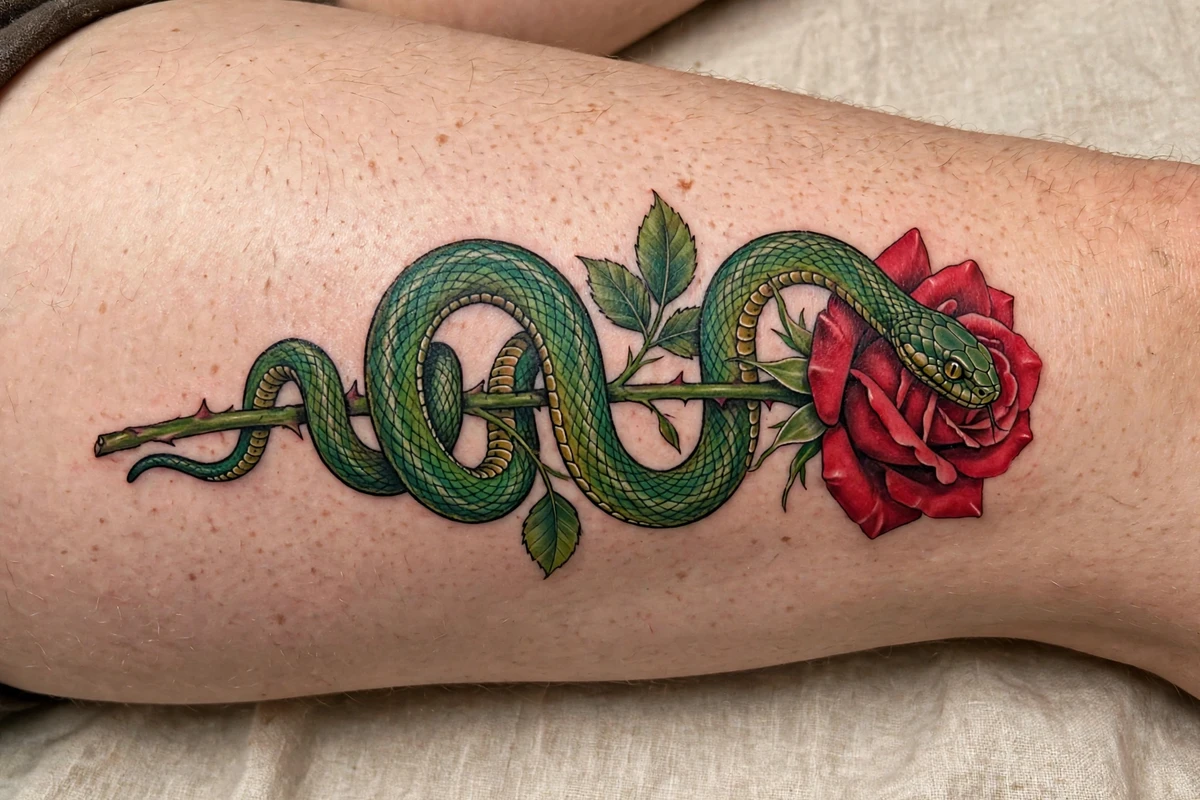
A rose wrapped in a snake is one of the boldest combinations in tattooing. The snake’s curves coil naturally around the stem and bloom, and the pairing has long been read as a symbol of temptation, danger and desire — beauty with a warning attached.
This design needs an artist comfortable with both floral work and animal anatomy, because a stiff or awkward snake will ruin the effect. The snake can be coiled tightly around the stem or draped loosely across the petals, with its head resting near the bloom. Black-and-grey suits it well, though a touch of green or red in the snake adds drama.
Placement: Forearm or thigh, where the snake’s coils have length to wrap around the rose.
18. Rose and Dagger
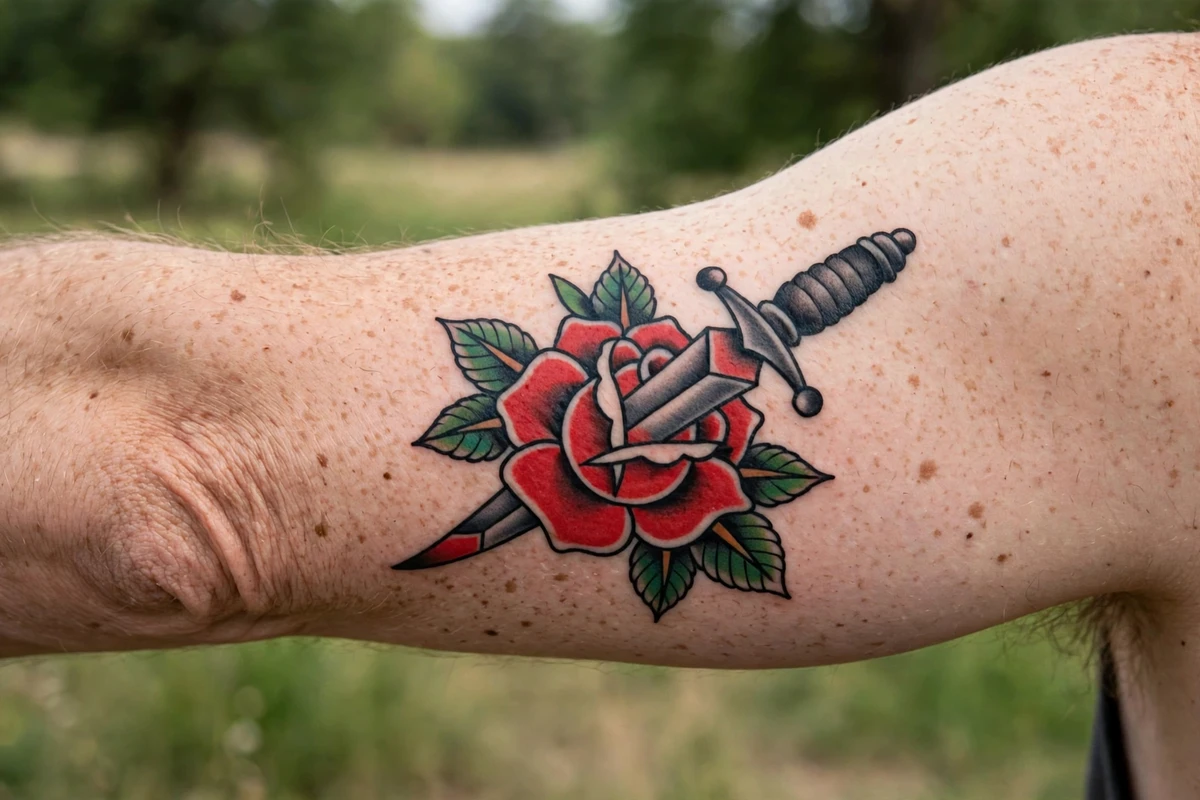
The rose and dagger is a classic old-school pairing: the softness of the flower against the sharp steel of the blade. It has been inked for decades as a symbol of love and loss, of beauty protected by strength — or of a love that cut both ways.
Traditional styling suits this design best: bold outlines, solid colour in the rose, a clean steel-grey blade. The dagger usually pierces through the bloom or rests diagonally behind it, with a few drops of red or a small banner adding detail. It is a design with attitude, and it reads best when kept bold and simple.
Placement: Upper arm or thigh, large enough for both the rose and the dagger to be clearly defined.
19. Rose on the Ankle
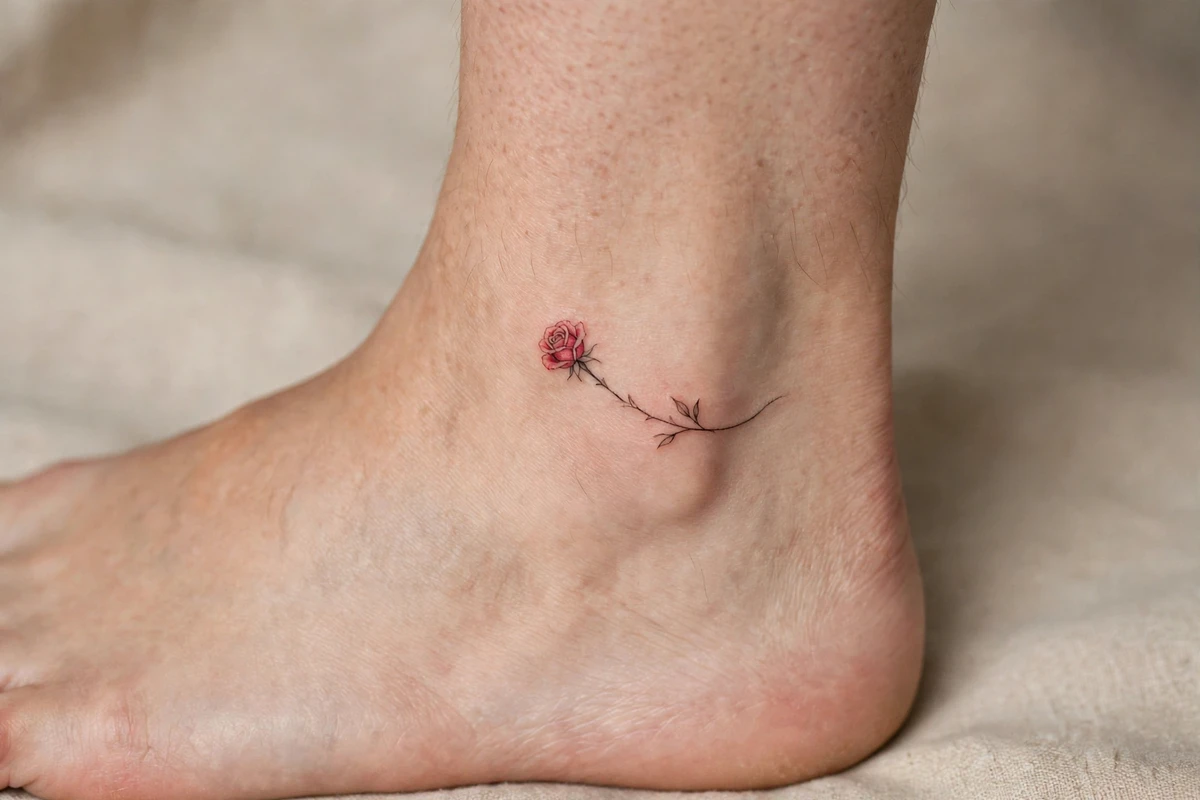
An ankle rose is small, delicate and easy to hide — a quiet tattoo that only shows when you choose to show it. A single small bloom, or a rose with a short trailing stem wrapping slightly around the ankle bone, is all it needs.
The ankle is a bonier spot, so expect a little more discomfort than a fleshy area, and keep the design simple so the lines stay clean on the curved surface. A fine-line or lightly shaded rose works best here; heavy detail tends to get lost at this size.
Placement: Outer ankle, just above the bone, or wrapping slightly toward the back of the ankle.
20. Rose and Clock
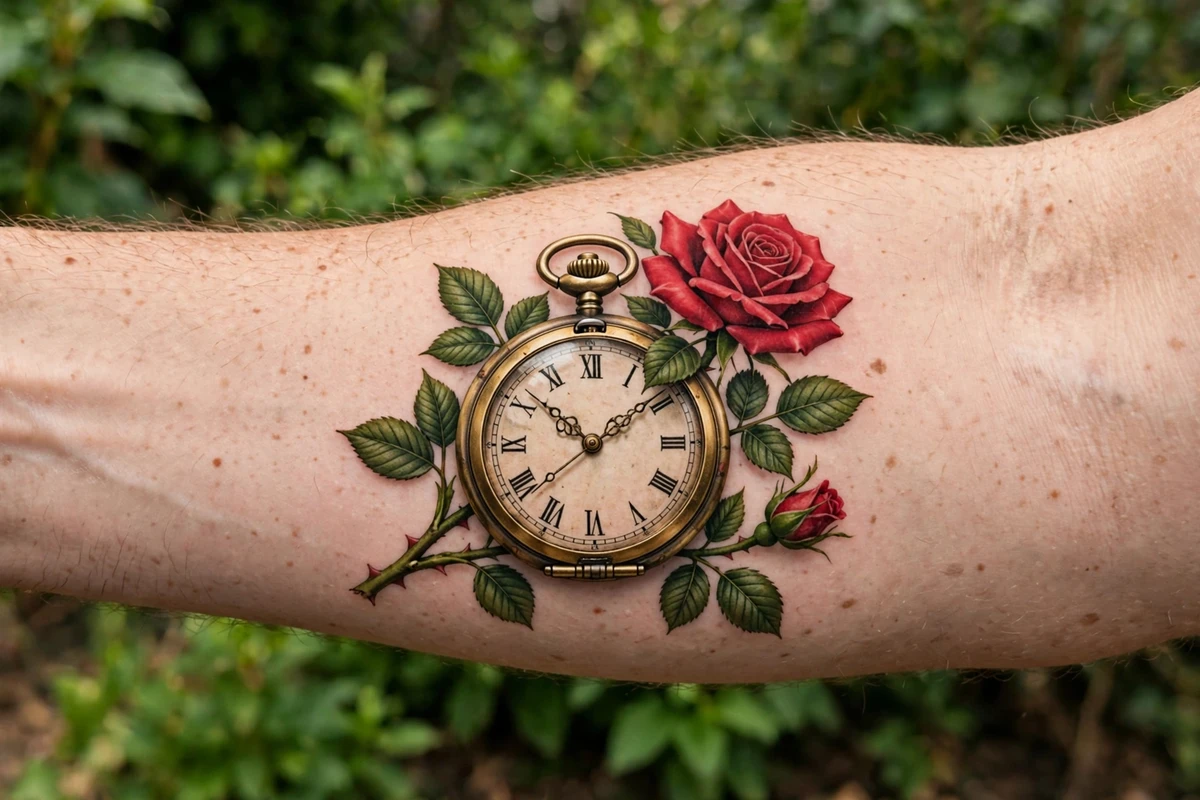
A rose paired with a clock — often a pocket watch or a clock face with the hands stopped at a meaningful time — is a design about time itself: how quickly it passes, and what endures. It is a thoughtful choice for marking a birth, a loss or a turning point.
The clock can sit behind the rose, with the bloom growing over the face, or beside it, with the stem wrapping around the case. Roman numerals suit the vintage feel of the design. If the time on the clock means something specific to you, make sure the artist sets the hands exactly right.
Placement: Forearm or upper arm, where the round clock face and the rose can sit side by side.
21. Minimal Outline Rose
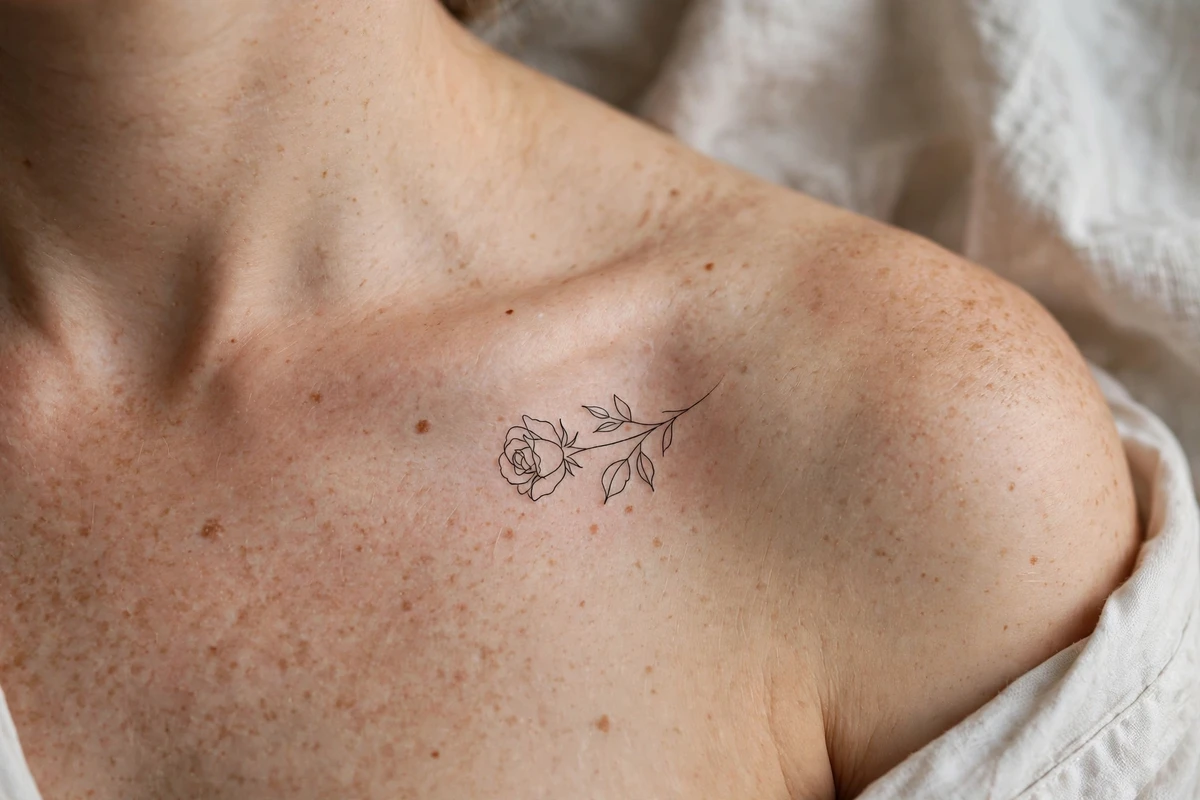
A minimal outline rose is nothing but the essential lines of the bloom — a single continuous line in some versions, a few clean strokes in others. It is the quietest design on this list, and for many people it is the most beautiful.
Because there is no shading or colour to fall back on, the linework has to be perfect. Choose an artist with a strong fine-line portfolio and be honest about how small you want it: go too small and the lines will blur together as the tattoo ages. Done right, it is a tattoo that feels more like a sketch that happened to be beautiful.
Placement: Behind the ear, on the collarbone or on the inner forearm — small, clean spots that suit minimal work.
Conclusion
The rose has survived every trend in tattooing because it adapts to all of them. It can be bold or delicate, colourful or black and grey, tiny or filling a whole back — and it can carry a meaning that is entirely your own. Whatever style you lean toward, the same advice applies: find an artist whose healed work you admire, talk through the size and placement with them, and let the design be a starting point rather than a finished picture. Your rose should look like it belongs to you, not to a template. If you want more floral inspiration, take a look at our 21 sunflower tattoo ideas or our 21 snake tattoo ideas — and when you are ready, book the artist whose roses you keep coming back to.