
Ultraviolet (UV) and infrared (IR) light are invisible forms of radiation that lie at opposite ends of the visible light spectrum. Despite being invisible, they play a huge role in our daily lives and industries, powering everything from TV remotes to water purification systems. By examining the properties, sources, and applications of UV and IR light, we can understand their differences and why they are crucial for technological progress.
Understanding Ultraviolet (UV) Light
Ultraviolet light occupies the portion of the electromagnetic spectrum located between X-rays and visible light. It packs a significant amount of energy into a very small space, which gives it unique physical and chemical properties.
Definition and Wavelength Range
UV light operates on a short wavelength, typically ranging from about 10 to 400 nanometers. Because the wavelengths are so short, UV radiation carries a high frequency and high energy levels. This high energy allows UV light to penetrate and alter cellular structures.
Natural and Artificial Sources
The sun serves as the most abundant natural source of UV radiation on Earth. While the Earth’s atmosphere absorbs a large portion of this light, enough reaches the surface to sustain life and occasionally cause sunburns. On the artificial side, engineers have developed specialized UV lamps, light-emitting diodes (LEDs), and lasers to harness this energy for controlled commercial and industrial use.
Common UV Applications
The high-energy nature of UV light makes it incredibly useful across various sectors.
- Sterilization and disinfection: UV-C light, a specific sub-band of ultraviolet radiation, effectively destroys the DNA and RNA of bacteria and viruses. Hospitals and laboratories use this technology to sterilize air, surfaces, and medical instruments.
- Water purification: Municipalities and private facilities use UV light to neutralize harmful microorganisms in drinking water without relying on harsh chemicals like chlorine.
- Curing: Industrial manufacturing heavily relies on UV light to instantly dry and cure inks, coatings, and adhesives. Maintaining these complex manufacturing systems often requires sourcing specific UV equipment spare parts to ensure continuous, high-speed production.
- Medical treatments: Dermatologists use controlled UV exposure to treat skin conditions like vitiligo and psoriasis, helping to slow down abnormal skin cell growth.
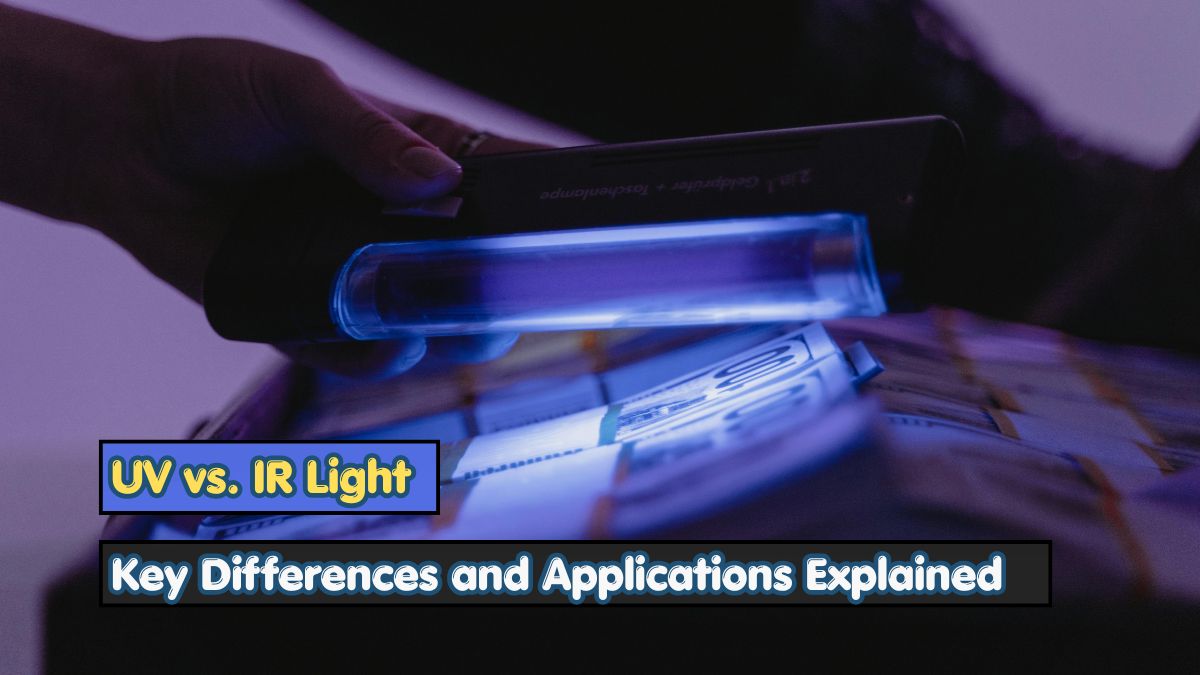
- Forensics: Law enforcement and forensic experts use UV lights at crime scenes to detect bodily fluids, fingerprints, and even counterfeit currency that remains invisible under normal lighting.
Safety Considerations
Because UV light carries high energy, prolonged exposure can cause cellular damage. It leads to sunburns, premature skin aging, and increases the risk of skin cancer. Direct exposure to the eyes can also cause severe damage to the cornea. Proper protective measures, such as UV-blocking safety goggles and protective clothing, are mandatory when operating artificial UV systems.
Exploring Infrared (IR) Light
Infrared light sits just beyond the red end of the visible spectrum. Unlike the high-energy nature of UV radiation, infrared is fundamentally associated with heat and thermal energy.
Definition and Wavelength Range
Infrared wavelengths stretch from 700 nanometers up to 1 millimeter. These wavelengths are much longer than those of visible and ultraviolet light, which translates to a lower frequency and lower overall energy.
Natural and Artificial Sources
Everything in the universe that emits heat naturally produces infrared radiation. This includes the sun, a warm cup of coffee, and the human body. Artificial sources of infrared light include IR emitters, specialized heat lamps, and IR LEDs commonly found in consumer electronics.
Common IR Applications
Infrared technology excels in scenarios that require sensing, communication, and heat transfer.
- Thermal imaging and night vision: IR cameras capture the heat signatures emitted by objects and living beings. This allows military personnel, firefighters, and wildlife researchers to see clearly in total darkness.
- Remote controls: Most standard television and audio remote controls use short pulses of IR light to transmit commands to the receiving device.
- Fiber optics communication: Telecommunication networks use near-infrared light to transmit vast amounts of data through fiber optic cables. IR light travels through these glass fibers with minimal signal loss, enabling high-speed internet connections.
- Heating: Infrared heaters provide direct, therapeutic warmth in saunas. Industrial sectors also use IR heating panels to bake paints and mold plastics.
- Spectroscopy: Scientists use IR spectroscopy to analyze materials. By observing how a substance absorbs infrared light, they can identify its specific chemical composition.
Safety Considerations
Infrared radiation is generally safer than ultraviolet light, but it still requires respect. Intense or prolonged exposure to high-power IR sources can cause thermal burns to the skin. Additionally, looking directly into powerful industrial IR lasers can damage the lens and retina of the eye, making specialized safety glasses necessary in certain laboratory environments.
Key Differences Between UV and IR Light
While both exist outside the realm of human vision, UV and IR light sit on opposite ends of the spectrum and interact with the physical world in fundamentally different ways.
Wavelength and Energy Levels
The most defining difference lies in their physical structure. UV light features short wavelengths and high energy. IR light features long wavelengths and low energy. This energy gap dictates exactly how each type of light behaves.
Interaction with Matter
When UV light strikes an object, its high energy often causes photochemical reactions. It possesses enough power to break molecular bonds, which is why it can destroy the DNA of a virus or instantly cure a liquid resin into a solid plastic. IR light interacts with matter by causing molecules to vibrate. This molecular vibration generates heat, which explains why IR is used for thermal imaging and warming spaces.
Primary Applications
Because of their different interactions with matter, they serve entirely different industries. UV dominates the realms of sanitation, chemical processing, and detailed forensic analysis. IR excels in temperature sensing, short-range digital communication, and space heating.
Biological Effects
Biologically, UV poses a risk of cellular mutation and DNA damage. IR primarily poses thermal hazards, acting similarly to a hot stove rather than a radioactive source.
Complementary Uses and Emerging Technologies
Despite their differences, modern engineering frequently brings UV and IR technologies together to create highly advanced systems.
Systems Integrating Both UV and IR
Advanced agricultural facilities use integrated light systems to optimize crop yields. They might use IR sensors to monitor the precise temperature of the plant canopy while deploying specific UV wavelengths to trigger natural defense mechanisms in the plants, reducing the need for chemical pesticides. High-end security systems also combine the two, utilizing IR motion detectors to track movement in the dark while using UV-sensitive scanners to verify authorized identification badges.
Future Trends
The future points toward extreme miniaturization. As LEDs and microscopic sensors become cheaper and more powerful, we will see UV and IR technology integrated heavily into wearable tech. Smartwatches could eventually use IR to monitor deep-tissue blood flow, while simultaneously utilizing UV sensors to alert users when they have been exposed to too much sunlight.
Conclusion
Ultraviolet (UV) and infrared (IR) technologies are two different ways humans manipulate the electromagnetic spectrum. High-energy UV light is used to sterilize hospitals, cure materials, and investigate crime scenes. Lower-energy IR light offers the thermal properties needed to track heat signatures, enable global communication, and heat our homes.