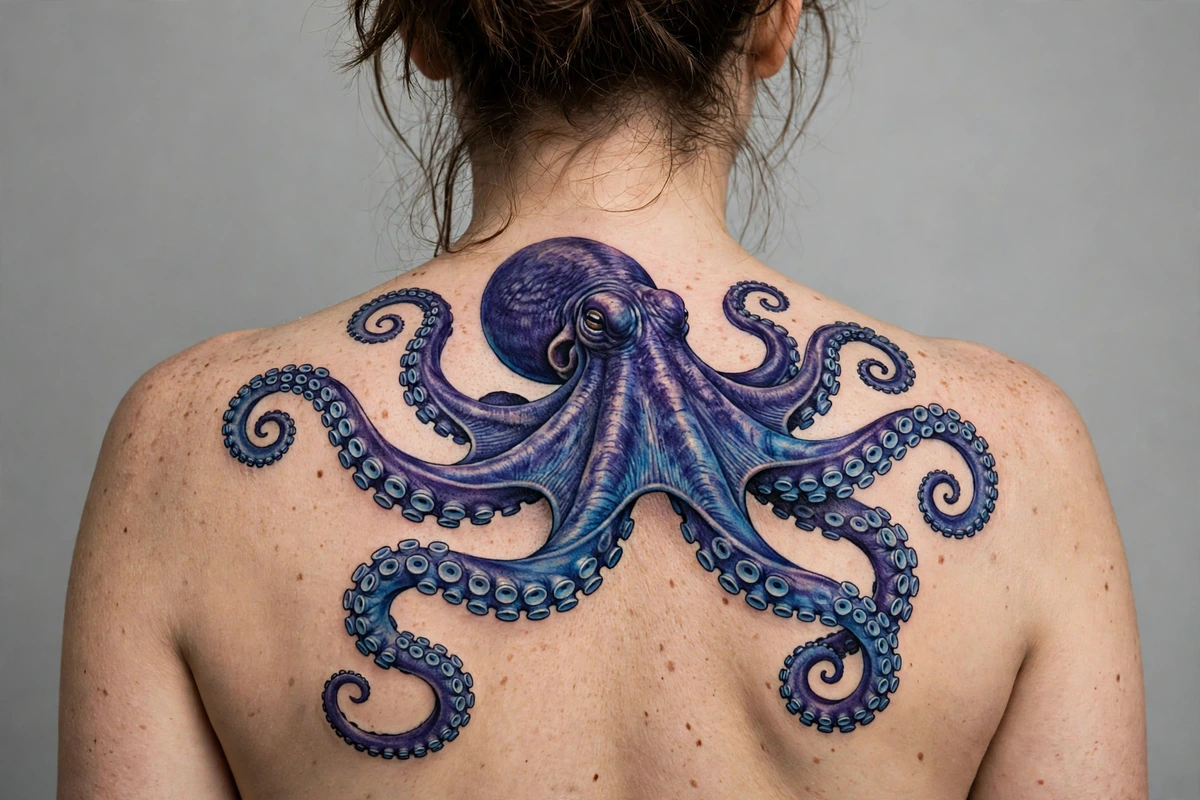
Introduction
Few sea creatures translate into tattoo art as naturally as the octopus. Its eight arms are already a finished composition: curling lines, rows of suckers, and a soft, rounded head that gives the artist a clear focal point. A good tattoo artist barely needs to invent anything. The animal supplies the movement, the texture, and the drama, which is why octopus tattoos work at almost any size, from a small curling arm on the wrist to a full back piece with tentacles reaching across both shoulders.
The symbolism is part of the appeal too. The octopus is one of the cleverest creatures in the ocean, able to solve puzzles, squeeze through tiny gaps, and change its colour and texture to vanish against the reef. People choose octopus tattoos for intelligence, adaptability, and freedom — the ability to slip out of any tight spot — and just as often for the mystery of the deep sea itself.
This list covers ten distinct ways to wear the octopus, from bold realistic showpieces to fine-line and black-and-grey work. Each idea comes with a placement suggestion, so you can picture how it would sit on real skin. Take the design that matches your style, show it to your artist, and let them adapt the lines and colours to your body.
10 Octopus Tattoo Ideas
1. Realistic Octopus with Curling Tentacles
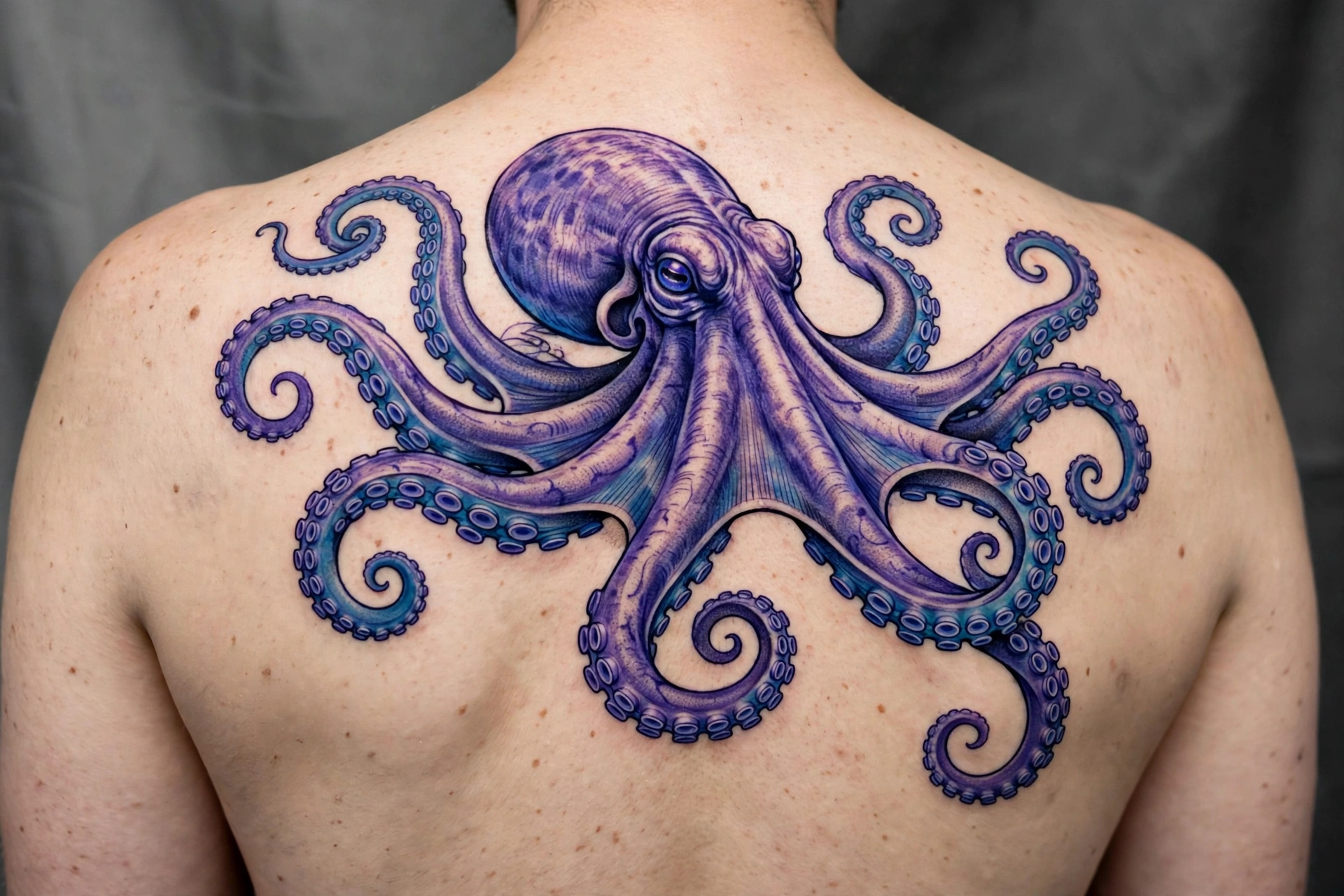
This is the classic octopus tattoo and still the most striking: the animal shown in full, its head rounded and textured, its eight arms curling and twisting in different directions, each sucker picked out in careful detail. The design uses the whole spread of the arms as its canvas, so the artist can layer deep purples, blues, and rusty reds across the skin while keeping the head as the anchor of the piece.
A design this detailed needs room. It works best where the skin is broad and flat, so the tentacles can curl without crowding each other. Ask your artist to sketch the arms to fit the shape of the area first, then fill in the sucker detail, rather than shrinking a ready-made design to fit.
Placement: Upper back or thigh, where the tentacles have space to curl freely.
2. Minimalist Octopus Outline
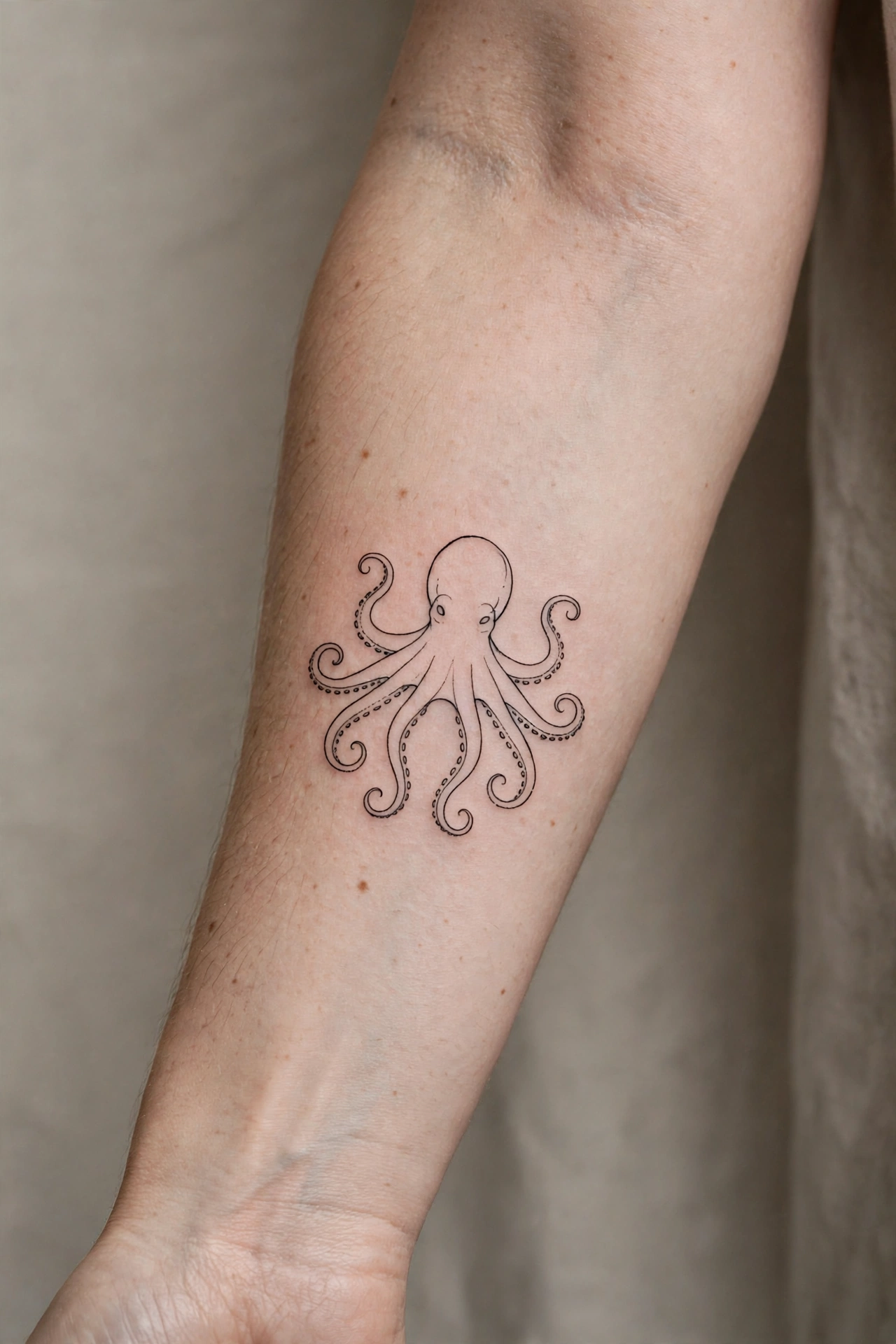
Minimalist octopus tattoos strip the animal down to a few confident lines: the curve of the head, the suggestion of eight arms in sweeping strokes, a hint of suckers in small dots. No shading, no colour, just the shape. The effect is quiet and modern, and it suits people who love the octopus’s silhouette but do not want a large, colourful piece.
The risk with fine-line work is going too small. Lines that are too thin or too close together can soften and spread over time, so give the design a little breathing room and choose an artist who specialises in fine line. A slightly bolder outline than you first imagine usually heals into exactly the delicate look you wanted.
Placement: Inner forearm, ankle, or behind the ear for a truly subtle version.
3. Watercolour Octopus
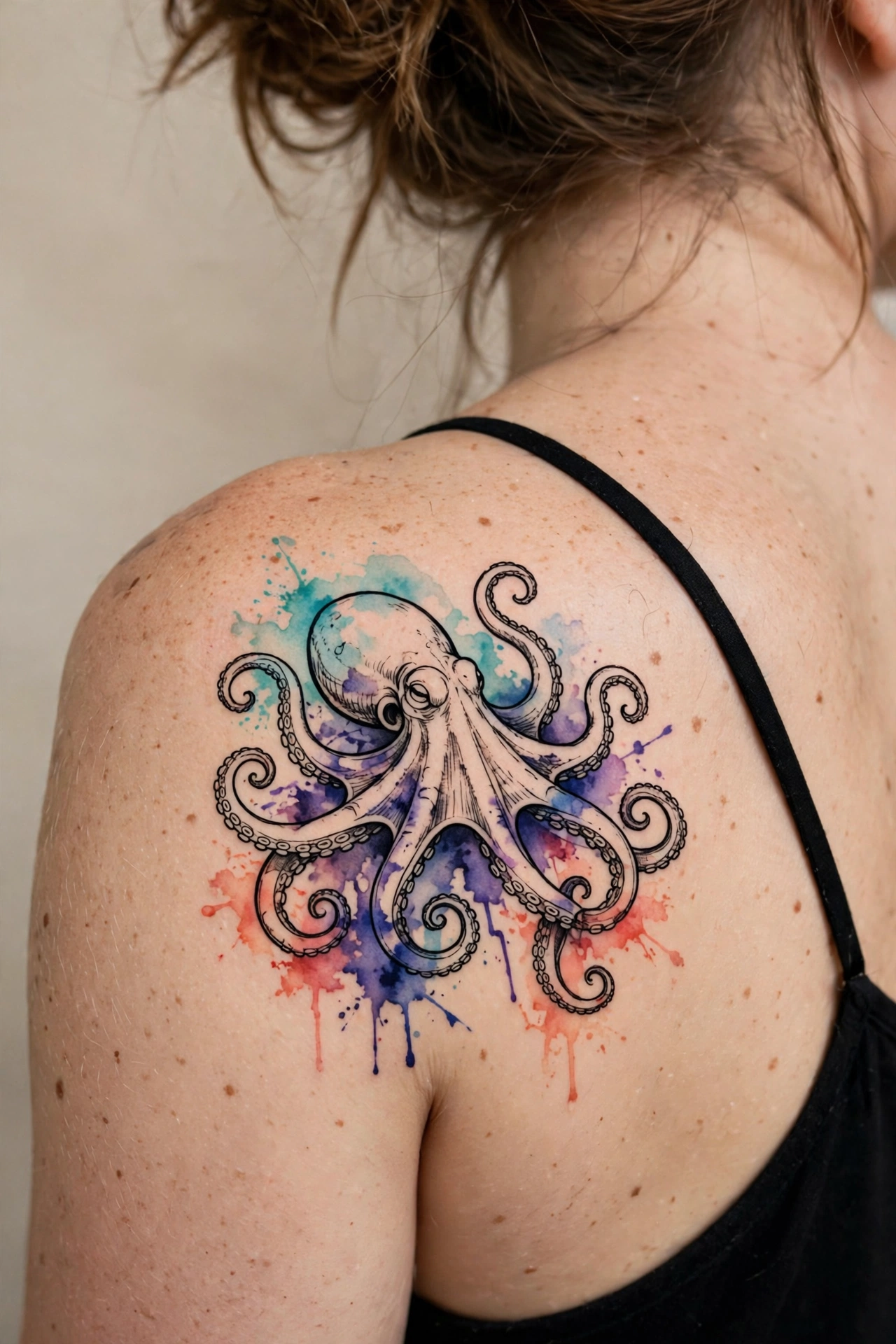
Watercolour style turns the octopus into a painting. The animal is drawn in clean black line work, then washed with loose splashes of turquoise, violet, indigo, and coral that bleed softly past the outlines, as if the colour were still wet. It is a natural match for this creature: a real octopus already shifts through these colours as it moves across the reef, and the watercolour technique exaggerates that quality instead of fighting it.
Because the colour sits in soft washes rather than solid blocks, placement matters. Choose flatter skin where the washes can spread evenly, and expect your artist to use a light black outline to hold the design together. Sunscreen becomes non-negotiable with this style — faded watercolour loses its magic fast.
Placement: Shoulder blade, upper arm, or side of the ribcage.
4. Geometric Octopus
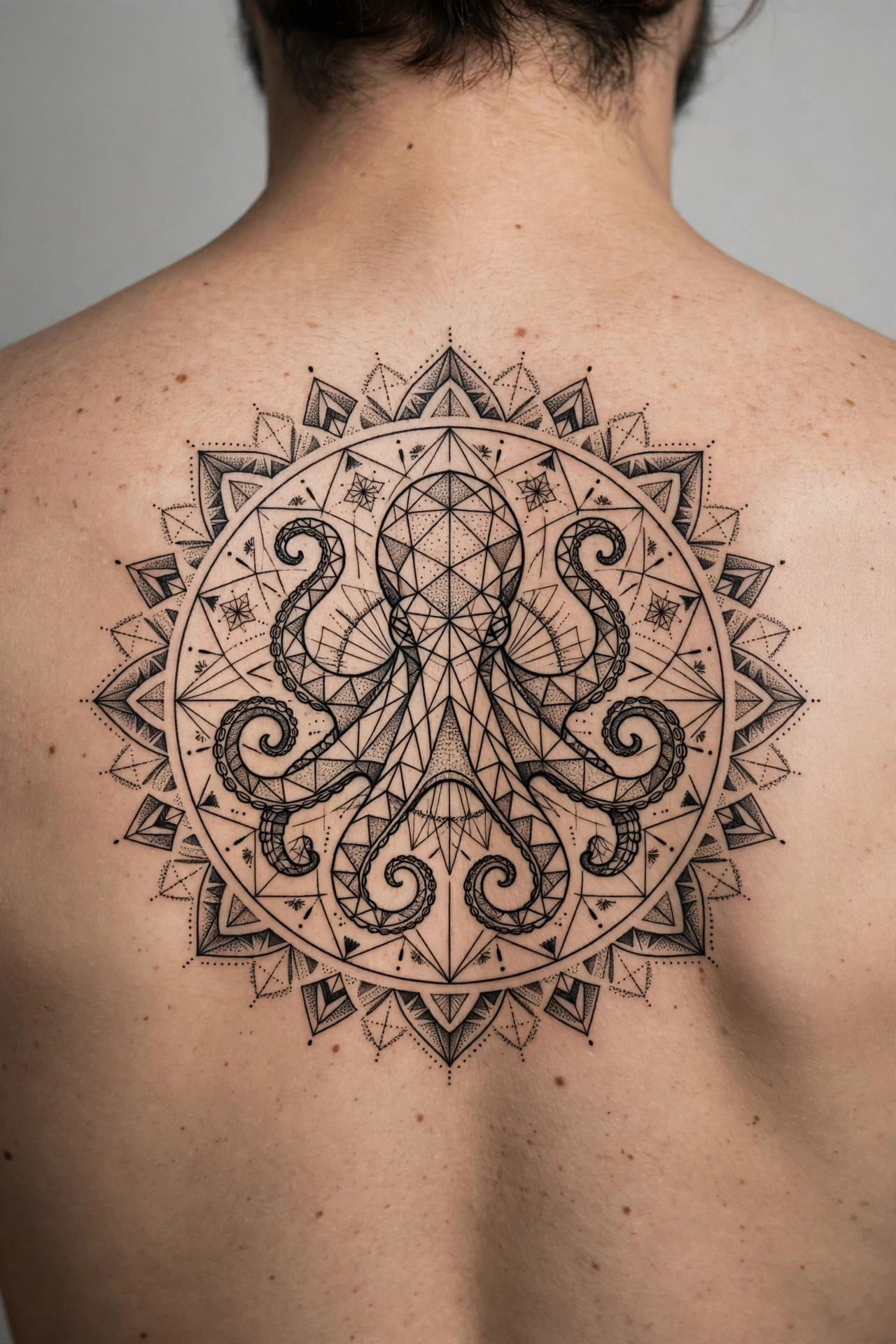
Geometric octopus tattoos rebuild the animal from triangles, lines, and dots, often inside a mandala-like circle with the arms arranged in perfect symmetry. The head becomes a set of concentric shapes, each tentacle reduced to a clean curve of repeating segments, and the suckers drawn as neat rows of dots. The style suits people who like structure and symmetry, and it photographs beautifully because the pattern is so deliberate.
Symmetry is the whole point here, so the design must be planned carefully. A geometric piece that is even slightly off-centre will show it forever, so a good artist will stencil it, step back, and check the alignment against your body’s own lines before a single needle touches skin.
Placement: Centre of the upper back, chest, or outer thigh, where symmetry can be kept true.
5. Octopus and Coral Reef
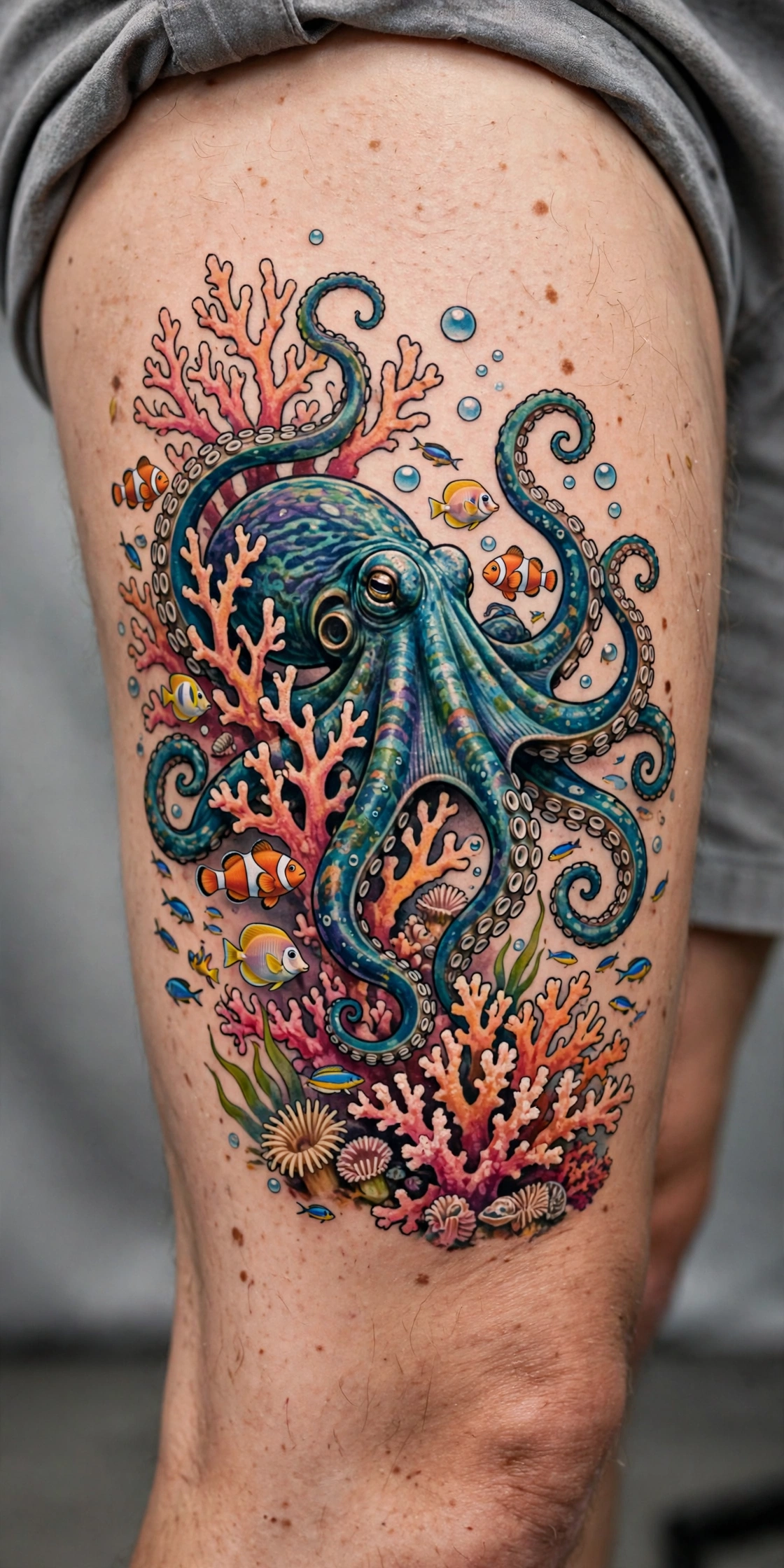
Pairing an octopus with a coral reef sets the animal in its own world. The coral brings branching shapes and warm pinks, oranges, and golds that balance the octopus’s cooler purples and blues, while a few small fish or bubbles add life around the edges. The usual arrangement sets the octopus’s head rising above a cluster of coral at the base, with one or two tentacles curling down to wrap gently around a branch. If you love ocean designs generally, our 9 turtle tattoo ideas offer another sea creature in the same spirit.
This is a generous design that rewards a larger canvas, because both the animal and the reef need room to breathe. Ask for the coral to be drawn at a similar scale to the octopus’s head so neither element overpowers the other.
Placement: Thigh, upper arm, or as a side piece running from hip to ribs.
6. Small Octopus on the Wrist
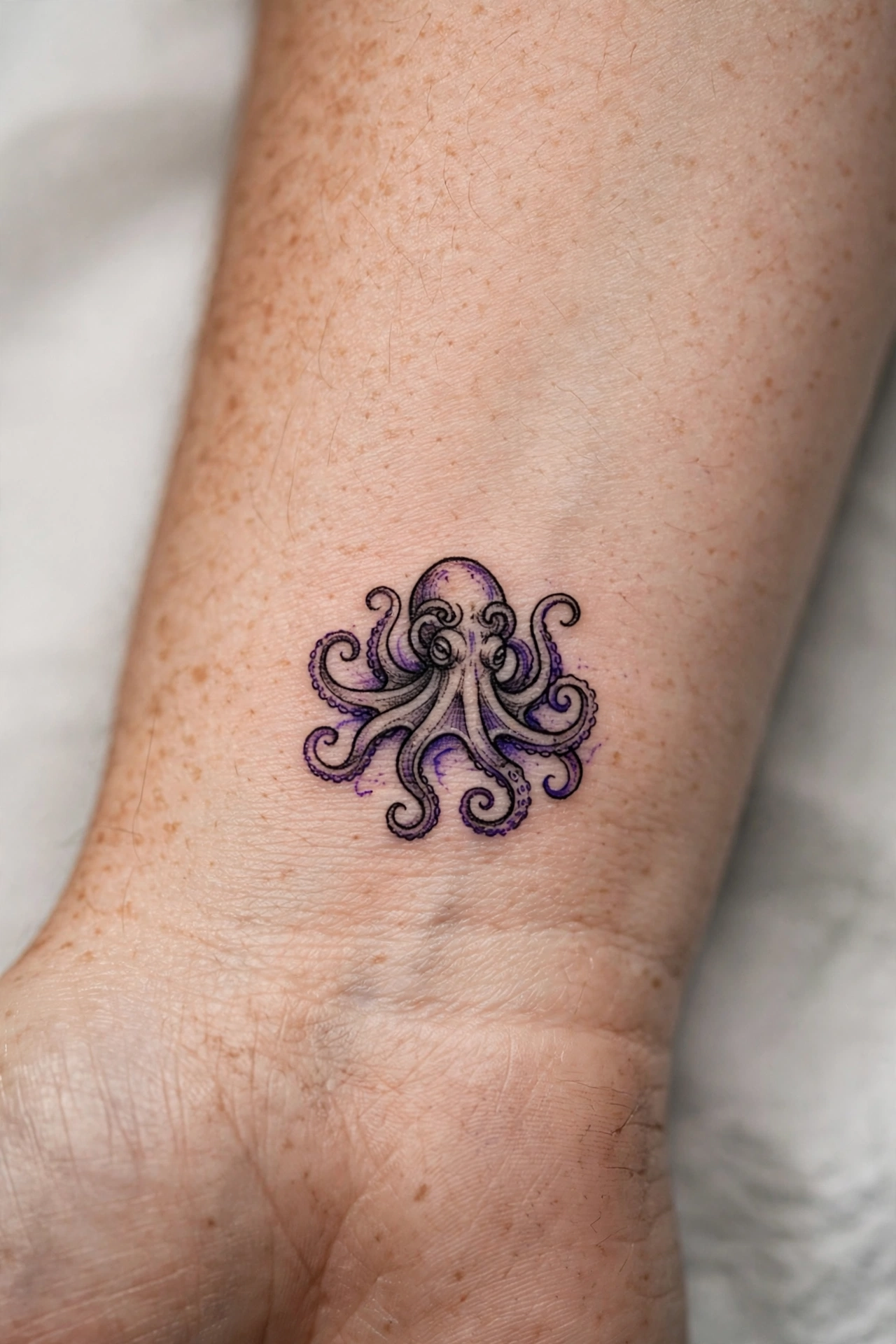
A small octopus on the wrist is the animal at its most wearable. The design is usually just the rounded head with eight short, curling arms, small enough to sit neatly on the inner or outer wrist. It reads as a piece of jewellery, catches the eye when you move your hand, and carries the same symbolism as a full octopus — intelligence, adaptability, freedom — in a form that fits everyday life.
Small tattoos demand a steady hand. The suckers are a tiny arrangement of dots, and at wrist size there is no room for a wobbly line, so choose an artist with proven fine-detail work and resist the urge to shrink the design further than they advise.
Placement: Inner or outer wrist, or just above it on the lower forearm.
7. Black-and-Grey Octopus
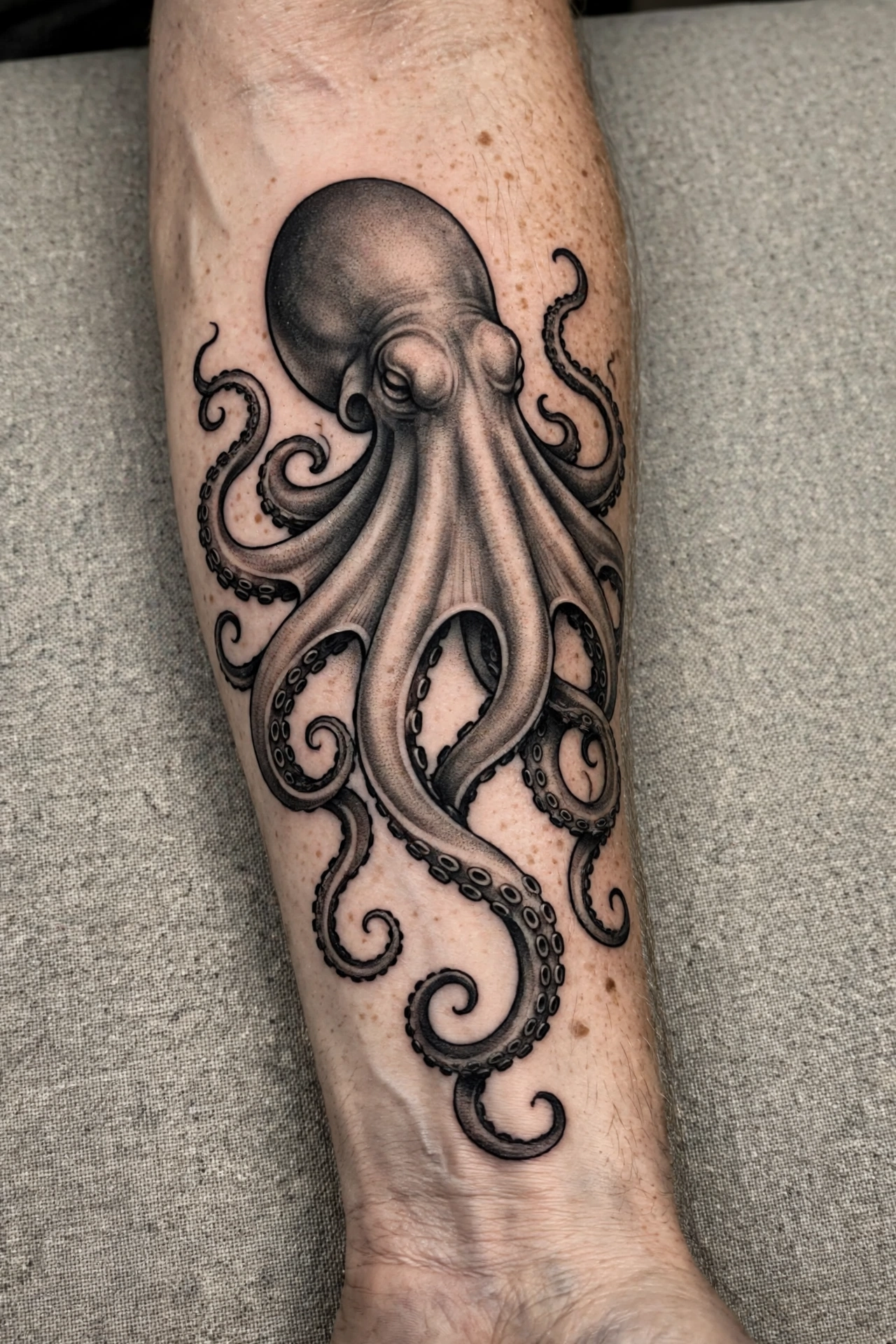
An octopus does not need colour to be recognisable. In black and grey, the design leans on shading instead: smooth gradients across the head, fine whip-shading along the tentacles, and deep black in the suckers to make them stand out. The result is elegant and understated, closer to an engraving than a painting, and it suits anyone who wants the animal’s drama without a bright, colourful tattoo.
The challenge is keeping the tentacles distinct without colour to separate them. Your artist needs strong shading skills and a light touch — too much solid black and the arms turn into a dark mass; too little contrast and they blur together. Look at healed black-and-grey work in your artist’s portfolio, not just fresh photos, before you commit.
Placement: Forearm, calf, or shoulder, where the shading can be seen clearly in natural light.
8. Octopus and Anchor
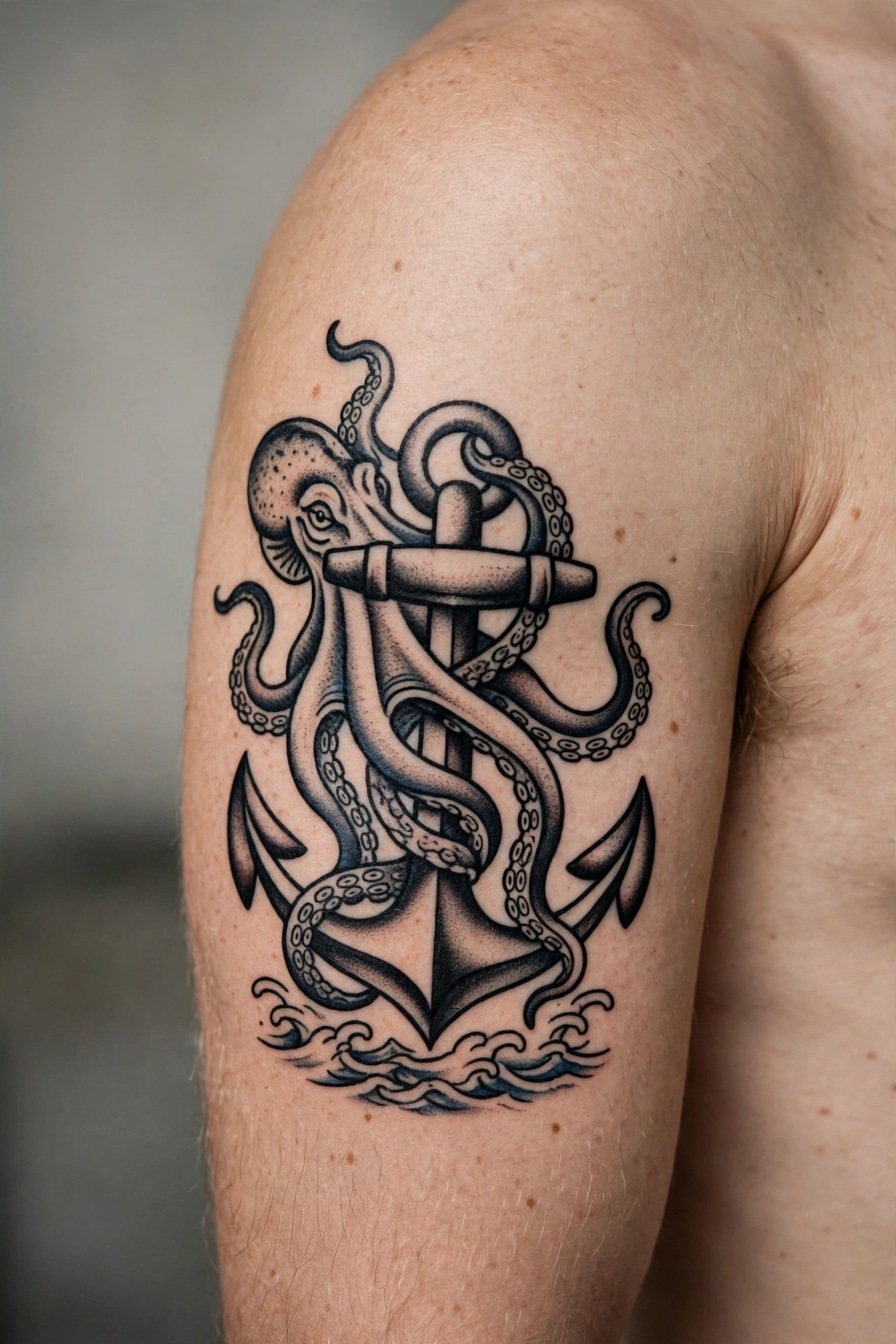
The octopus and the anchor are a natural nautical pairing: one stands for freedom and escape, the other for steadiness and holding fast. The usual arrangement wraps one or two tentacles around the anchor’s shank, with the rest of the arms curling out around it, and sometimes a rope or a few waves added at the base. Together they make a design about balance — staying grounded without losing the freedom to move.
This is a popular choice for people with a real connection to the sea, from sailors to divers, but it works just as well as pure imagery. Keep the anchor bold and simple so it reads clearly at a distance, and let the octopus carry the finer detail.
Placement: Upper arm, chest, or calf, where the anchor can sit upright.
9. Octopus Holding a Pearl
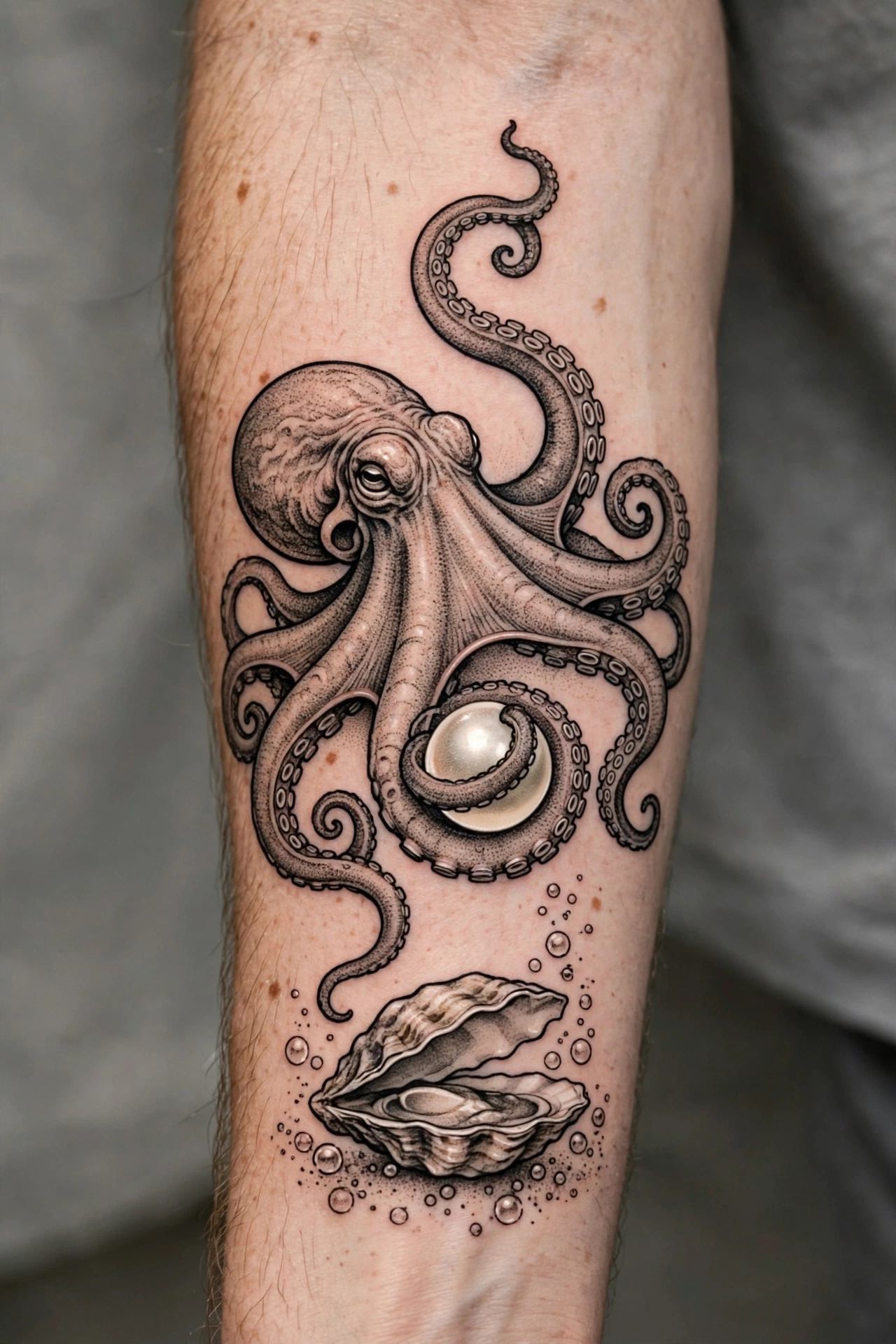
In this design, one tentacle curls gently around a single pearl, held up like a small treasure. The pearl’s smooth, pale glow contrasts beautifully with the octopus’s textured skin, and the image carries a quiet meaning: something precious, found in the deep and held carefully. A few small bubbles or a half-open shell at the base can complete the scene without crowding it.
The pearl is the detail that makes or breaks this piece. It needs a soft highlight and a gentle shadow to look round rather than flat, so ask your artist to give it real dimension instead of a plain white circle.
Placement: Forearm, shoulder, or upper thigh, where the pearl can sit at the centre of the design.
10. Full Back Octopus Piece
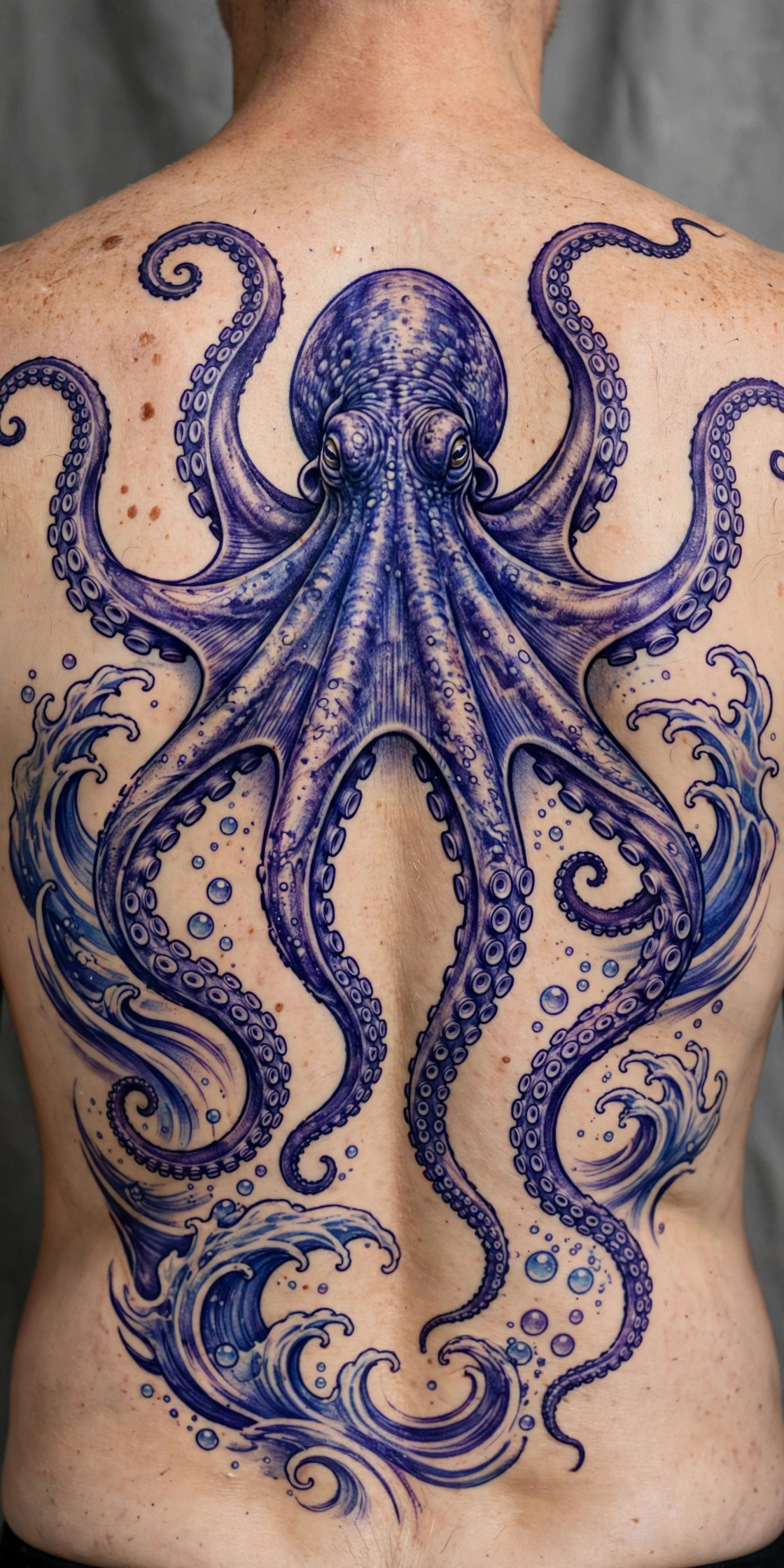
A full back piece is the octopus tattoo taken as far as it can go: the animal life-size or larger, its head between the shoulder blades, its eight arms reaching down toward the waist and out toward the arms, sometimes with waves, coral, or drifting bubbles filling the edges. It is a commitment of many hours and several sessions, but the back is the one place where all eight arms can spread at their true scale. For another large showpiece in a different style, our 10 peacock tattoo ideas show how a fanned tail can fill a back in much the same way.
Plan this one like a project, not a single appointment. A good artist will map the design across your back in stages, usually starting with the head and the main arms, then adding tentacle detail and background in later sessions once the first work has healed.
Placement: Full back, from shoulders to lower back.
Closing
Octopus tattoos work because the animal does half the artist’s job: the shape is beautiful, the movement is already decided, and the symbolism gives the design a meaning worth carrying. Whether you choose a small curling arm on the wrist or a full back piece, the key is the same — give the design enough space, pick an artist whose strength matches the style, and let the octopus’s own lines lead.